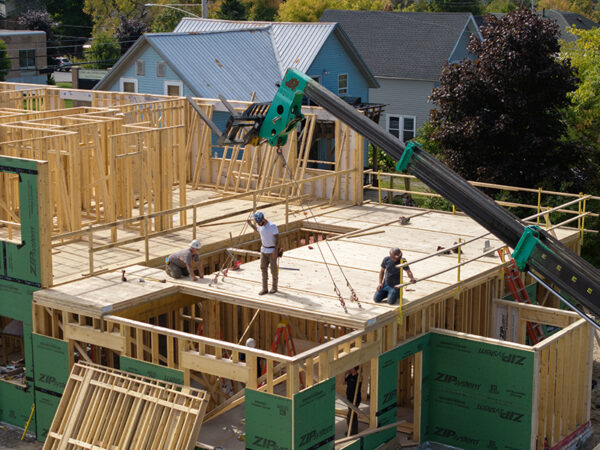
Thanks in part to the speed of construction with mass timber, the Center’s 9-unit apartment building under construction in Tupper Lake, NY, was closed in before the first snow.
Mass Timber Speeds Progress on Tupper Lake Apartments
An exciting project is taking shape in Tupper Lake, NY. The Center is creating nine new places for people to live, and we’re using mass timber to speed up construction of the nine-unit apartment building.
“Mass timber” is a whole category of engineered wood products made by bonding or fastening smaller wood pieces (like lumber) into large, strong structural components (panels, beams, columns) that can replace concrete and steel in construction. The Center is using both mass timber beams and floor assemblies in the building.
For floor assemblies, picture large pre-constructed panels that include the finished ceiling of the first floor, the structural elements between floors, and the subflooring of the upstairs space.
Construction teams say that the pre-assembled units helped speed up that phase of construction, were easy to use, and cut down on labor.
“To our knowledge, this is the first building within the Adirondack Park using cross-laminated timbers (CLT),” said Leslie Karasin, Adirondack program director for the Center. “We documented what we’re doing here in a video so we can share our experience using these exciting products with as many people in the building professions as possible. We’d like to see mass timber and wood-based insulation become the norm in this region.”
“We’re excited about progress on the building and optimistic that we will be able to wrap up the project on schedule,” said Karasin. “These nine apartments will serve the community’s critical need for housing and we have found ways to maximize the benefits of this project for the forest economy as well.”
The Center’s short video about the project showcases the innovative wood products that are employed in the building design. These include:
Cross-laminated timbers (CLTs) are employed as the floor assembly in a portion of the building and for porches.
Glulam beams are used as structural members.
Wood-based insulation will be employed in place of fiberglass or spray foam.
Crews install cross-laminated timber floor assemblies in the Center’s apartment building. The CLT panels add to the sustainability of the building and shave valuable time off the construction process.
The building was largely boxed in before the first snow flew in November and the hardy construction crew from JFP Enterprises has continued to push exterior work toward completion, while teams of subcontractors have been able to get a jump on the rough electrical, mechanical and plumbing work on the building’s interior as well as complete the roofing.
The construction schedule aims for completion by Labor Day of 2026.
Several of the design and building professionals who are involved in the project appear in the video, speaking about the advantages of these products, including carbon sequestration, convenience, savings on time and labor, and aesthetics.
“It has been exciting to use cross-laminated timbers, glulam posts and wood-based insulation in this project,” said Andrew Allison, principal at AJA Architecture. “I see the industry trends for these products really taking off. The product is easy to work with, it saves time and labor, and it looks beautiful in the finished design. For all of those reasons, I think people are really going to start gravitating towards this.”
In addition to using CLT produced by Sterling Structural, the project incorporates other wood-first, climate-smart products such as wood-based insulation produced by TimberHP in Madison, Maine, and glulam beams manufactured by Unalam south of the Adirondacks. These choices create beautiful living spaces that are also examples of sustainable construction.
The U.S. Forest Service provided financial support for the video and for design costs for using innovative wood products in the building. Other funders for construction of the building include New York State Homes and Community Renewal through the Downtown Revitalization Initiative, New York Empire State Development through Restore NY, private investments through the Center’s Northern Forest Fund, and donations from individuals and foundations.
The Center has used a “wood-first” approach in all of its housing construction to support the local forest economy and reduce the building’s carbon footprint while creating much-needed housing.
Make a Gift Today to Support Community Revitalization Projects Like This!
Your gift will support projects like this all across the Northern Forest!