Timber Way: ‘The potential to transform rural housing’
Northern Forest Center’s Timber Way development to feature beautiful mass timber housing, filling gaps in middle-market housing
Five years ago, Maura Adams was sitting by the ocean in Portland, Maine, with Mike Wilson talking about the Northern Forest’s housing crisis.
They had heard from community after community that housing was a critical challenge. That there weren’t places that young people and workers could afford to live. That businesses — like hospitals — were struggling to hire and retain employees. Not only was the housing shortage limiting economic growth, but it was driving young people away and their future away with them.
The Northern Forest Center — an organization focused on community revitalization and forest economy — was looking for solutions. It had already started with adaptive reuse in Millinocket, Maine, and Lancaster, New Hampshire, to create more middle-market housing. Developing housing was new but essential territory for the Center, for which Adams serves as the director of community investment and Wilson serves as a senior program director.
They were talking about the next steps toward solving the middle-market crisis in Greenville, Maine.
“In our great wisdom, we were like, ‘Well, we’ve done some adaptive reuse. How much harder could it be to build 24 houses on a lot? We’ve already done hard things. This is just another hard thing,’” Adams recalled.
Five years later in late August, Adams was standing at that lot with 50 community members, team members, donors and partners for the groundbreaking ceremony of the Center’s Timber Way housing development.
“This is a really hard thing as it turns out,” Adams said, looking around. “But we come from a spirit of we can figure things out. We get really smart people involved, we look to others for partnership. We just kind of keep going, even when it makes us slightly crazy.”
Infrastructure Project
The Center just finished a public infrastructure expansion on property in partnership with the town of Greenville, which extended public water and sewer service and constructed a new town road, Timber Way, onto the property. Funding for the expansion came largely from a grant from the Northern Border Regional Commission.
“One of the biggest barriers to the housing development on this site has been the infrastructure,” said Greenville Town Manager Michael Roy. “While there was interest in building a subdivision here back in 2010, the necessary public infrastructure was simply not in place to support the private investment. The Northern Forest Center stepped in as a true problem solver, helping the town overcome that challenge by securing funding, managing complex project requirements, and bringing together the right partners to move the project forward. … Most importantly, this critical infrastructure was completed without additional tax burden to local taxpayers. That’s huge.”
A Vision for Middle-Market Homes
Now, construction begins for 24 new homes. Homes at Timber Way are expected to start for less than $300,000. Deed restrictions will ensure that they’re used as full-time, year-round residences and can’t be flipped for high profit. It is all to help offer housing options to full-time, year-round residents.
“I’m so proud that we’re making this happen,” Adams said. “There is so little housing being built in this region, and it’s so desperately needed. Anytime you see any kind of new construction or development going up, it’s like the big house on 5 acres. This is addressing a totally different need. There’s going to be restrictions on these houses so that they’re for full-time year-round residents, and they’re going to be very economically priced.”
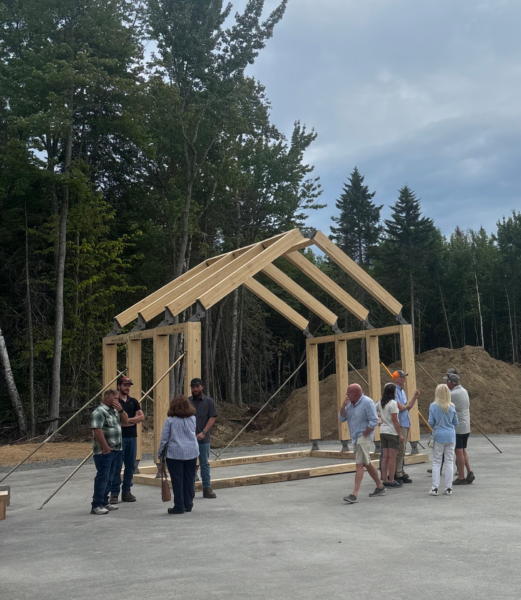
TMBR demonstration frame at Timber Way in Greenville, Maine.
For this project, the Center is working in partnership with TMBR, a mass timber design company, to create quality homes using an innovative mass timber system customized for rural places. The mass timber homes will feature open concept floor plans and range from roughly 1,000–1,600 square feet.
“They’re beautiful homes. And, to be able to bring that level of quality and comfort to a place like Greenville at a price people can afford is just something we’re so proud of,” Adams said. “But this is the first place where these homes are going to be built at scale that have the potential to transform rural housing across the country. Which is so exciting to see this happening in Greenville.”
“This is not about putting up a house cheaply; it’s about putting up a house with integrity that really feels good when you come into it,” said Rob Riley, Center president. “We’re putting a lot of heart into it. When you walk into one of these houses, you feel comfortable, you feel safe, you just feel at home, and that’s also paired with the incredible price point and efficiency.”
The work, as Adams, Wilson and Riley all noted, would not be possible without incredible community partners.
“This is a dream come true,” said Margarita Contreni, president of the Moosehead Lake Region Economic Development Corp. “My colleagues and I are delighted to have played a part in the pre-development of this project, evaluating local housing demand, hosting informational sessions for businesses and residents, exploring funding opportunities, making a six-figure investment. We are ecstatic to see the construction begin. We know that, in the near future, our employers’ struggle to recruit workers and grow their business will ease, and more families will make Greenville their home.”
The Timber Way project is expected to serve as a model for developments across the Northern Forest as the Center was recently awarded a $300,000 grant by the U.S. Forest Service to complete predevelopment work for at least one mass timber housing development in each Maine, New Hampshire, Vermont, and New York.
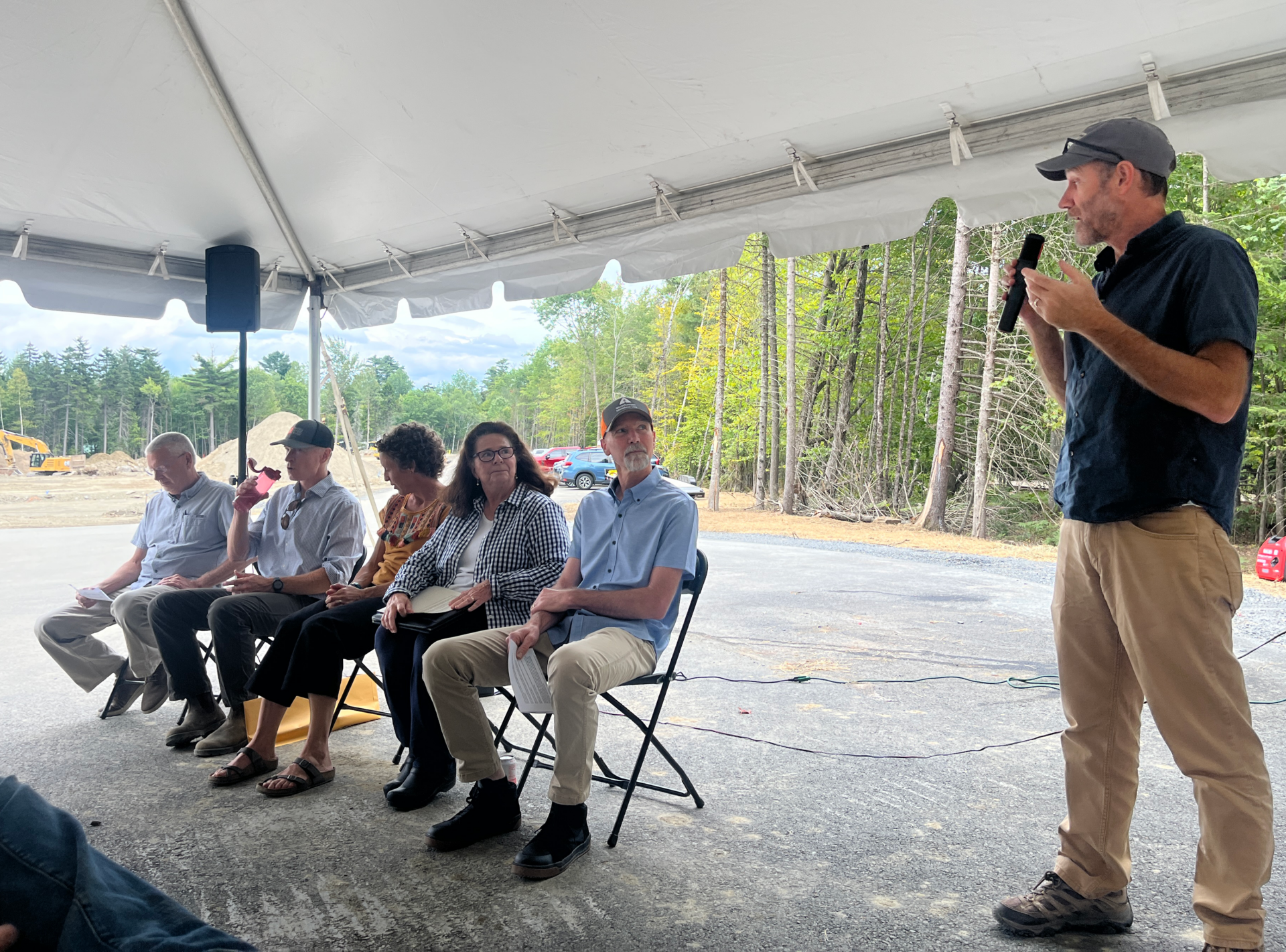
Mike Wilson, senior program director at the Northern Forest Center, speaks during the groundbreaking ceremony at Timber Way in Greenville, Maine, in August 2026.
The Timber Way housing initiative builds on the Center’s other past and current work in the Moosehead Lake region, which includes funding for an Extended Learning Opportunity coordinator in the local high school, producing the new Moosehead Outdoor Recreation Investment Strategy, providing grants to downtown businesses to improve storefronts, helping to redevelop the lakefront boardwalk and Crafts Landing Park, and providing business innovation grants to tourism-related enterprises.
The Northern Forest Center has purchased 5 acres in downtown Greenville, Maine to develop middle-income housing that will help meet the Mooshead Lake Region's desperate need for rental housing.