Center Launches Downtown Redevelopment in St. Johnsbury
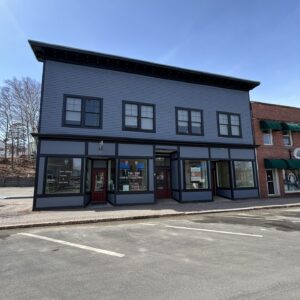
The Center has purchased 560 Railroad Street with plans to redevelop the building as a mix of small commercial rentals and middle-market housing.
“Downtown has seen great recent investment, and our project will continue that trend,” said Rob Riley, president of the Center. “As an investment and innovation partner for Northern Forest communities, the Center is making strategic investments in properties that will provide quality rental housing for the area’s workforce while also adding to the vitality of our communities.”
We plan to redevelop the 15,000-square-foot building with two commercial spaces and approximately 10 apartments, with a mix of 1- and 2-bedroom units. The building was built in 1906 for use as an armory and was converted into a hotel in the 1930s.
“One of our greatest needs as a community is market rate housing that can help attract workers to live here,” said Joe Kasprzak, St. Johnsbury’s assistant town manager. “We appreciate that the Center brings capacity to rural communities to help them solve complex problems such as housing. The Center’s model for development is something no community our size can do on its own.”
 The Center uses a mix of funding sources to make these projects financially feasible. Sources include impact investment funds, tax credits, and private gifts and grants. The Center also seeks to bring new philanthropic support to the community to support programs that include improving recreation access and resources, assisting wood products and tourism-related businesses, advancing sustainable tourism, developing Community Forests, and building area non-profit capacity.
“This long-awaited investment in 560 Railroad Street mirrors the positive changes we are seeing throughout downtown St. Johnsbury,” said Gillian Sewake, director of Discover St. Johnsbury. “The timing couldn’t be better to bring new housing and improved retail options to the community. We can’t wait for this historic property to shine once again as a cornerstone of our downtown district.”
Local Advisors Guide Project
“We’ve been working with a group of local advisors who steered us toward 560 Railroad Street as a property with a lot of potential for creating quality downtown housing and commercial space,” said Riley. “Our aim is to create middle-market housing that will be attractive to young families and people who contribute to the community through their work as teachers, health care providers, entrepreneurs, and as community leaders.”
A rough timeline for the project calls for design work through the winter, with construction to potentially start next fall, and new leases to begin in 2025. The Center will issue requests for proposals for work on the project as it develops.
The Center’s Northeast Kingdom Program Manager, Evan Oleson, will oversee the redevelopment project alongside the work he does to support sustainable tourism in the region.
The Center is using capital from its Northern Forest Fund – which integrates private investment dollars, philanthropic donations, and grants from public sources – to fund the purchase and its initial redevelopment expenses. The Northeastern Vermont Development Association-led Brownfields Assessment Coalition has made a major contribution to the project by funding more than $64,000 of environmental assessment. The redevelopment will remedy any contaminants at the site, such as lead paint and asbestos in the building, and pollutants in soil.
“We are seeing lots of interest from local partners who want this project to succeed, such as Northeastern Vermont Regional Hospital, which has an ongoing need for housing to accommodate new and existing staff,” said Riley. “We have local individuals who have invested in the Northern Forest Fund, and we’re talking with other organizations that we expect will be major contributors.”
The St. Johnsbury initiative follows completion of two other major property initiatives: In Lancaster, N.H., the $3.5-million redevelopment of the Parker J. Noyes building, which created 6 middle-market apartments and commercial space for a local nonprofit and food marketplace; and the Millinocket (Maine) Housing Initiative, which invested more than $1 million to renovate six homes, creating 12 quality rental units from properties that had been severely neglected.