A Current‑to‑Future Analysis for Mass Timber in the Northern Forest
New analysis examines the potential for regional supply chain.
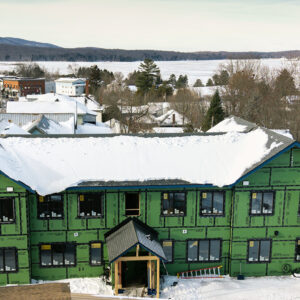
Mass timber products like cross-laminated timber (CLT) panels and glue-laminated timber (glulam) beams are gaining momentum as sustainable construction materials. The Northern Forest Center recently made use of these materials in our construction of new apartments in Tupper Lake, NY, and is planning to demonstrate a new mass timber housing typology in the construction of 28 homes in Greenville, ME.
For these projects, most of the mass timber components – and all the wood used to create them – were sourced from outside the Northern Forest states. What would it take for this to be different in the future?
This question is the focus of a new report, commissioned by the Northern Forest Center with funding from the Northern Border Regional Commission and the U.S. Forest Service. Compiled by the firms TMBR and Mass Timber Advisors, the report analyzes the current mass timber supply chain components in the Northeast and explores the future outlook and feasibility of a robust regional CLT/glulam supply chain. Key topics include raw material sourcing, existing production capacity, distribution channels, end-user demand, transportation logistics, supplier networks, code and policy drivers, future investment opportunities, and infrastructure needs.
Notable findings include:
- The Northeast is one of the last major wood-producing regions in North America without its own mass timber production, in comparison to areas of the Pacific Northwest, Southeastern U.S., Quebec, and Austria that have demonstrated that a cluster of mass timber manufacturing, supported by local species, can thrive.
- The region has ample raw materials (spruce, fir, hemlock, pine) that have been proven suitable for CLT and glulam; utilizing these species could add value to the forestry sector while improving forest health.
- Barriers to large-scale mass timber manufacturing the region include higher raw material costs, limited Machine Stress-Rated lumber production and kiln-drying capacity, fragmented log procurement networks, and the absence of strong state-level incentives.
- Plans are on the table for establishing facilities in Maine and possibly elsewhere, and state support and private interest are coalescing towards the possibility of at least one plant becoming reality in the coming years.