The view from a clearing in Bethel Community Forest in Maine. (Jerry Monkman photo)
Center Purchases Property in Bethel, Maine, for Redevelopment
The Center has purchased a significant property in Bethel, Maine, to redevelop as middle-market housing to support the community.
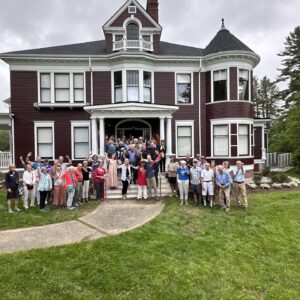
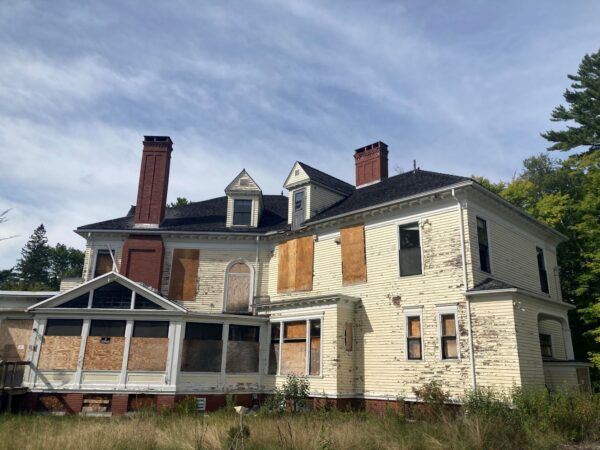
The 10-acre property includes a historic building, known as the Gehring House, that has been vacant for years. Initial redevelopment will restore the historic integrity of the building and create eight quality 1-2 bedroom rental apartments. The Center expects to build new homes on a portion of the adjacent acreage in the future to further expand local housing opportunities.
The Center and former property owner Paul Boghossian reached agreement in early December, enabling both parties to achieve their goals. The sale closed on Dec. 15. This will be the Center’s fifth housing redevelopment project, following successful initiatives in Millinocket, Maine, and Lancaster, New Hampshire, and new projects launched in Tupper Lake, N.Y., and St. Johnsbury, Vermont.
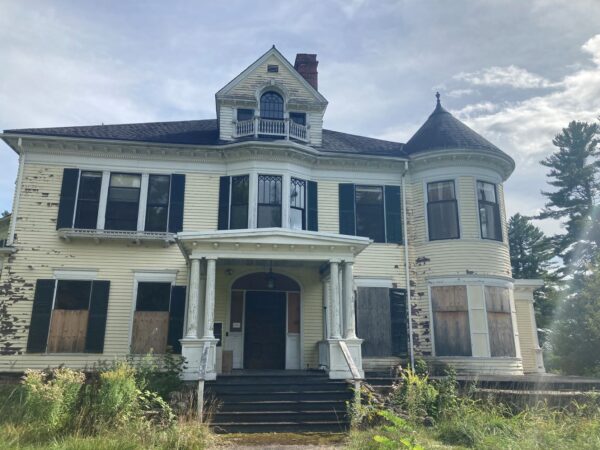
Paul Boghossian acquired the property with the intent of redeveloping the site which was previously home to the National Training Laboratories (NTL) Institute. “I’m pleased that the Northern Forest Center is in the position to create quality housing on this unique property,” said Boghossian. “Their goal is similar to mine in restoring the grand property and filling a community need.” In addition to adding substantially to the acreage of the site during his ownership, Boghossian was also able to secure historic tax credit approvals for the project.
“We are thrilled to acquire this important building in downtown Bethel and add housing development to the many community revitalization programs we have going on with partners in Bethel and the Maine West area,” said Rob Riley, president of the Northern Forest Center. “The tax credits Paul secured will be an invaluable tool to restore the historic house to its former glory and reposition it as vital housing for the community.”
This redevelopment project complements the Center’s ongoing work in the region, including projects that improve recreation access and resources, assist wood products and tourism-related businesses, advance sustainable tourism, develop Community Forests, expand broadband service, and build area non-profit capacity. “Our goal is to create vibrant communities and a regional economy that can attract and retain young people and families in rural communities across the Northern Forest region of Maine, New Hampshire, Vermont, and New York,” said Riley.
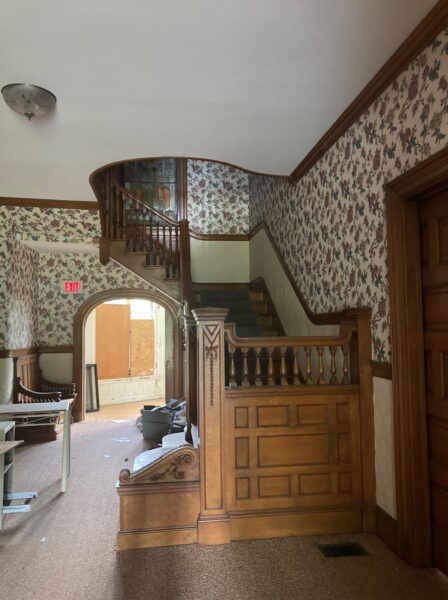 “The Gehring mansion, constructed in 1896, is one of the most architecturally and historically significant buildings in Bethel,” said William F. Chapman, executive director of Museums of the Bethel Historical Society. “The house served as the home of Dr. John George and Mrs. Marion True Gehring and the clinic where Dr. Gehring would treat patients from all over the United States. After years of watching and wondering what would happen to the property, we could not be more excited to know that it will be preserved and continue to serve in a community function.”
The Center will use a mix of funding sources to make the Gehring House redevelopment financially feasible. Sources include impact investment funds, tax credits, and private gifts and grants.
“Our aim is to create quality housing that will be attractive and financially within reach for young people and families who contribute to the community through their work as teachers, health care providers, entrepreneurs, hospitality professionals, and other roles,” said Amy Scott, the Center’s program manager, who will oversee the redevelopment project alongside her work managing the Maine West collaborative.
The Center previously completed two major property initiatives: In Lancaster, N.H., the $3.5-million redevelopment of the Parker J. Noyes building, which created 6 middle-market apartments and commercial space for a local nonprofit and food marketplace; and the Millinocket (Maine) Housing Initiative, which invested more than $1 million to renovate six homes, creating 12 quality rental units from properties that had been severely neglected.
The Center is using capital from its Northern Forest Fund – which integrates private investment dollars, philanthropic donations, and grants from public sources – to fund the purchase and its initial redevelopment expenses.