A new apartment building is rising on Upper Park Street in Tupper Lake, N. Y., – the first new construction of this scale in the community’s downtown area in recent memory. Ultimately, the new building, which sits just across from the high school, will provide nine new homes, help improve the eastern gateway to Tupper Lake, and ideally catalyze additional interest and investment in this area of Tupper Lake.
The Center is also using this project to demonstrate the efficiency and climate-smart choices of using cross-laminated timber (CLT) and other innovative wood products.
Development Uses Cross-Laminated Timber
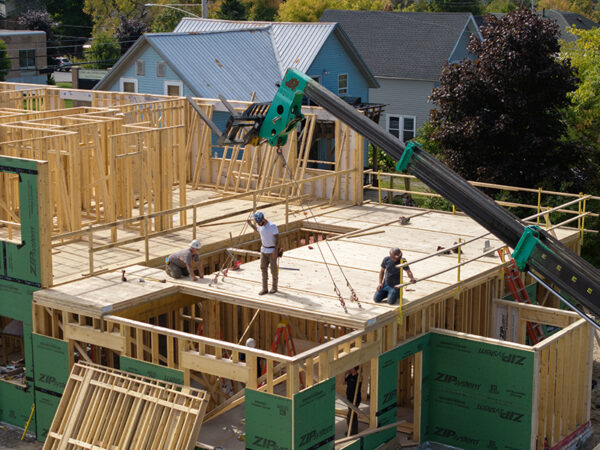
This summer, construction progressed from work on the foundation and utilities to framing, with the two-story building rapidly taking shape in August. Crews used a heavy machine to position pre-built CLT panels to serve as floor assemblies between the first and second stories in part of the building. Each panel provides the finished wood ceiling for the first floor, the structural assembly, and the subfloor for the second floor. Using the pre-built floor assemblies shaved valuable time off the construction schedule.
See Our Progress!
This highly visible community investment is already generating excitement and having a positive impact on Tupper Lake.
This “project is going to be transformative to this community,” said Mary Fontana, mayor of the Village of Tupper Lake. “It’s going to offer solutions to the workforce housing issue. We’re really excited to see the project come through.”
Framed Building Ready for Roofing
Crews install cross-laminated timber floor assemblies in the Center’s apartment building. The CLT panels add to the sustainability of the building and shave valuable time off the construction process.
By the end of September, crews had framed and sheathed most of the first and second floors and roof installation was ready to begin. The goal is to have the building fully enclosed before the snow flies to allow the construction team to continue working on the project throughout the winter.
The Center hired AJA Architecture Planning of Glens Falls to design the new building, and JFP Enterprises of Plattsburgh as the construction manager to lead the project. “We’re very excited to be working on this exciting project,” said Jon Poissant, owner of JFP Enterprises. “We can already see what the transformation of this site is going to mean for the community.”
In addition to using CLT produced by Sterling Structural, the project incorporates other wood-first, climate-smart products such as wood-based insulation produced by TimberHP in Madison, Maine. These choices create beautiful living spaces that are also examples of sustainable construction.
Project Supports Regional Forest Economy and Community Development
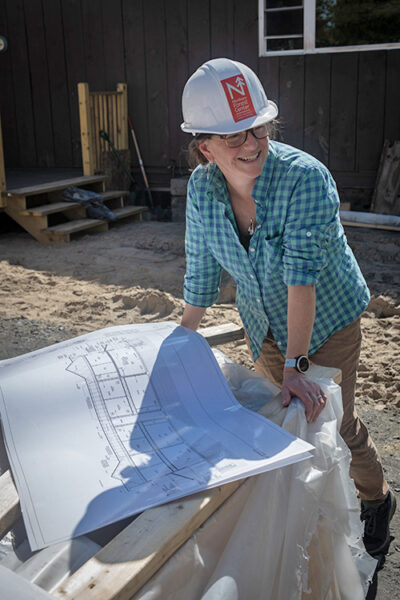
Center Adirondack Program Director Leslie Karasin oversees the new construction in Tupper Lake.
“With this new building, we’re using innovative wood products in the design and hoping it inspires others to explore these innovative materials too.” said Leslie Karasin, Adirondack program director with the Center. “As an organization, we support the forest products sector, looking for opportunities to strengthen our regional businesses through the sustainable use of forests and to encourage people to adopt new uses of sustainable forest products. We’re doing that here in our own project, in addition to serving the community development goals that are at the heart of this initiative.”
The Center is renovating an adjacent single-family home on Park Street as well. In all, the two projects will deliver 10 high quality rental homes to meet existing demand in the community, as well as improve the streetscape along this gateway into the downtown area.
Project Funding
The Center funds its housing projects through a combination of mission-driven investments, grants and donations. The project is made possible by funding from private investors through the Northern Forest Fund, private donors and foundations, and New York State, which is investing in this project through Downtown Revitalization Initiative funding administered by New York State Homes and Community Renewal, and Empire State Development’s Restore NY program.