
560 Railroad Street is a large brick building, originally built in 1909 to serve as the armory for Company D of the Vermont National Guard.
Center Begins Redevelopment of Historic Railroad Street Building in St. Johnsbury
Project Will Create 9 Apartments for Middle-Income Renters;
Catamount Arts to Lease One of Two Commercial Spaces
JOHNSBURY, VT: The first phase of renovations that will create upstairs apartments and first-floor commercial space – including a new community arts space – is underway at 560 Railroad Street.
The Northern Forest Center is redeveloping the historic, 15,000-square-foot property as part of its community revitalization work in St. Johnsbury. The project will create nine apartments with a mix of studio-, 2-, and 3-bedroom units and two commercial spaces. Rentals will be priced to serve median-income earners in the St. Johnsbury area.
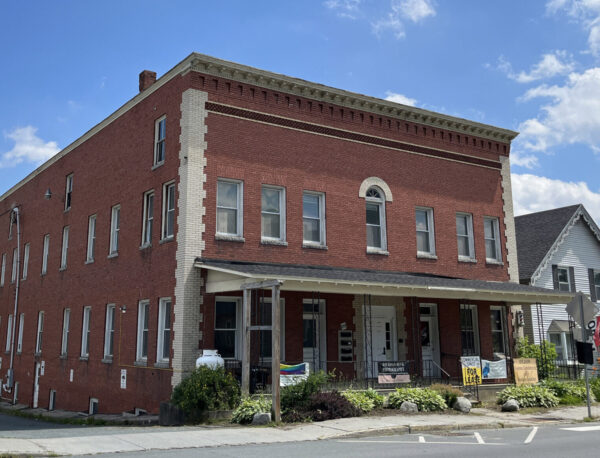
“This building has played such an important part in St. Johnsbury’s history,” said Center President Rob Riley. “We’re bringing it back to be a vital hub in the community again so it can contribute to the town’s future.”
“We’ve heard from the hospital and other employers that St. J desperately needs more housing for workers,” Riley said. “We’re excited to help fill that gap and now also to have Catamount Arts as a core partner to lease an artist in residence apartment and attached studio space. Residents, artists, and art enthusiasts will bring a lot of new energy to the north end of Railroad Street.”
Local Arts Involvement
Jody Fried, Executive Director at Catamount Arts, said the arts nonprofit will announce details about a new artist-in-residence program in the coming months. “Catamount is thrilled to work with the Center team to incorporate the arts and creativity into its core design for the 560 Railroad Street project,” he said. “Catamount’s goal is to create a vibrant new mixed-use housing model that can be replicated throughout the region that is intended to nourish and highlight the magic of working artists.”
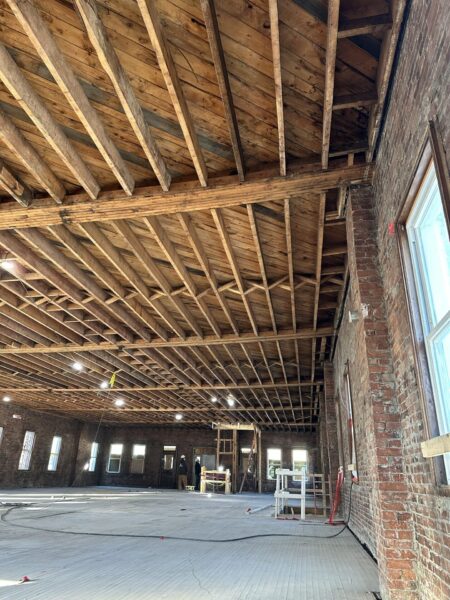
Interior demolition began in November 2023 and construction will begin in early 2024. Crews from EnviroVantage, based in Epping, NH, have stripped the building of all interior finishes in preparation for structural upgrades before interior reconstruction begins.
J.E. Bertrand built the building in 1909 to serve as the armory for Company D of the Vermont National Guard. The building was initially called Bertrand’s Hall and the wide-open first floor was used for Guard training as well as dances and events; the building was later converted into a hotel. The building’s construction used an unusual technique of “hanging” the second floor from above rather than supporting it from below to keep the first-floor space wide open.
Property Improvements
“We’ll be adding structural reinforcement throughout the building to meet modern codes,” said Evan Oleson, the Center’s project manager. “Our architect and engineers worked together to design a new floor plan that would make maximum use of the space for its new use,” said Oleson, referring to Alba Architects of North Woodstock, NH, and HEB Engineers of North Conway, NH.
The redevelopment of 560 Railroad Street will correct several pre-existing environmental problems on the property. “We’ve already removed a buried fuel oil tank and fortunately there is no evidence of a leak from that,” said Oleson.
“We’ll clean up contaminated soils on the parcel that likely resulted either from dirty fill added over time, or from aerial deposits from trains passing on the track behind the building,” he said. “We’ll also clean out regulated building materials used in the past, such as asbestos in pipe wrap and caulking.”
Companies involved in planning or implementing the environmental remediation include Weston & Sampson of Waterbury, VT; Clay Point Associates of Williston, VT; Catamount Environmental of Wilmington, VT; US Ecology of Williston, VT; and EnviroVantage.
“We are following a state-approved Corrective Action Plan, so there is careful oversight and clarity about how to correct these problems so the site can be used to the fullest,” said Oleson. “Without a major renovation like ours, it’s unlikely these potential hazards would have been addressed.”
Engineering Services of Vermont, based in Rutland and Waterbury, has designed the building’s all-new mechanical, electrical, and plumbing systems. HP Cummings, of Vermont and New Hampshire, will provide construction management.
Strong Public Support
“Construction will take just about a year,” said Oleson. “We’ll have rental information about the apartments available later this year. Anyone interested in leasing the second commercial space, which is about 562 square feet, should contact me for information.” Oleson can be reached at EOleson@northernforest.org .
The redevelopment project has received strong public sector support including the Town of St. Johnsbury, which provided a $150,000 “transformational grant” from its ARPA funds (the federally funded America Rescue Plan Act), the Vermont State Treasurer’s Office Local Investment Program, which provided a $500,000 low-interest loan to support housing development, and the Northern Border Regional Commission.
“This public sector support is a real vote of confidence in our approach and this project,” said Riley. “We’re confident this project will catalyze additional investment in downtown St. Johnsbury and build on the incredible vibe and pride of the community. This is a $5-million project and we’ve raised 70% toward our financing goal. We’d love to hear from anyone interested in supporting this revitalization effort.”
The Center used capital from its Northern Forest Fund – which integrates private investment dollars, philanthropic donations, and grants from public sources – to fund the purchase and cover initial redevelopment expenses. The Northeastern Vermont Development Association-led Brownfields Assessment Coalition made an important contribution by funding more than $64,000 of early environmental assessment work.
Other funders include Canaday Family Charitable Trust, Efficiency Vermont, The Freeman Foundation, Hoehl Family Foundation, Northern Border Regional Commission, Vermont Agency of Commerce & Community Development, Vermont Community Foundation, Vermont Department of Environmental Conservation, Vermont State Employees Credit Union, and individuals who have contributed to the Center’s Northern Forest Fund or to the project specifically.
In addition to the property redevelopment project, the Center supports efforts to improve recreation access and resources in St. Johnsbury, assist wood product- and tourism-related businesses, advance sustainable tourism, develop Community Forests, and build area non-profit capacity.
The Center previously completed two major property initiatives: In Lancaster, N.H., the $3.5-million redevelopment of the Parker J. Noyes building, which created 6 middle-market apartments and commercial space for a local nonprofit and food marketplace; and the Millinocket (Maine) Housing Initiative, which invested more than $1 million to renovate six homes, creating 12 quality rental units from properties that had been severely neglected.