Private Forests Provide Public Benefits – and are Under Threat
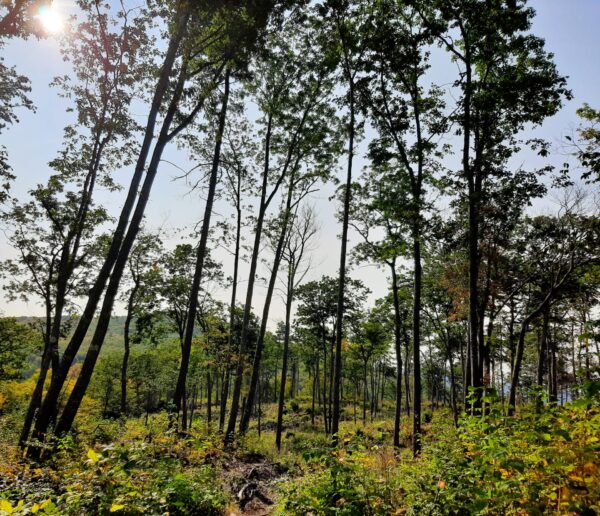
Among the many beautiful qualities of trees and forests is that they know no boundaries. The 26-million-acre Northern Forest, the largest intact forest in the Eastern United States, is an ecological gem spanning four states and uniquely identified places – New York’s Adirondacks, Vermont’s Green Mountains, New Hampshire’s North Country, and the Maine Woods. It is so expansive that, as a Maine landowner recently told us, “A lot of visitors assume this is a National Forest or park.”
It’s not. A unique feature of the Northern Forest is private ownership – 80% of the forest is owned and managed by individuals, families, tribes, investment groups, and industry – compared to the Western US, where 80% is publicly owned.
Another common but incorrect assumption is that the US Forest Service (USFS) only concerns itself with National Forests. The USFS supports the stewardship of public and private forests across the country, precisely because our forests span state boundaries and face challenges that are more efficiently and cost-effectively worked on in coordination.
With invasive pests and pathogens infiltrating the region and threatening ash, beech and hemlock stands, land sales by investor-owners looming, and tenuous markets for wood, now is the time to be investing in federal programs that address these issues at a landscape scale.
Instead, all USFS programs focused on state, private, and tribal forestry; forest research; and wildfire management are slated for deep reductions or complete elimination in the president’s FY26 budget proposal. These cuts will severely impact the state forest agencies that assist private forest landowners responsible for managing millions of acres of forest that provide clear air, clean water, and sustainable forest products and recreation that employ people and provide goods and services the American public wants and needs.
The targeted federal funds comprise substantial percentages of the annual budgets for state forest agencies in ME (15%), NH (13%), VT (33%), and NY. With federal funds eliminated, program losses and likely state employee layoffs will include:
- Forest health protection programs to detect, monitor and help protect private forests from the impacts of insects and diseases like spruce budworm, emerald ash borer, and beech leaf disease.
- Landscape restoration programs, which are competitive grants focused on forest landscape restoration and improved management.
- Forest stewardship programs that assist private landowners in managing forests for wildlife habitat, climate resilience, water quality, wood products, and other objectives.
- Urban and Community Forest programs that plant and maintain trees in developed areas and support the stewardship of town and community forests.
- Forest fire prevention, control and suppression at the town and state level.
States match federal contributions to these programs 1:1, creating an equal partnership and coordination between state and federal interests. As forests span state boundaries, this approach just makes sense, and it has worked for over 100 years.
Funding cuts that result in under-resourced states working in isolation is bad policy at a time when the Northern Forest faces significant threats from climate change, forest insects and disease, new land use pressures, and changing forest markets. Forests – and rural livelihoods that depend on them – are on the line. Let’s encourage Congress to continue investing in the USFS for our collective benefit.