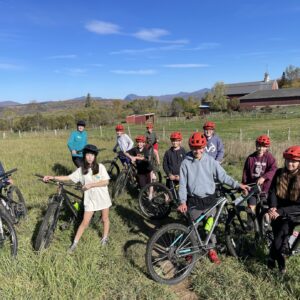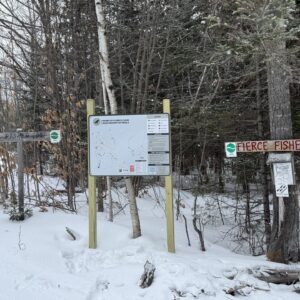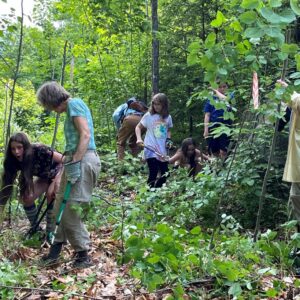
Trails on Observatory Knob. Photo by Kyle Gray for Vermont Land Trust.
Public Process and Public Lands
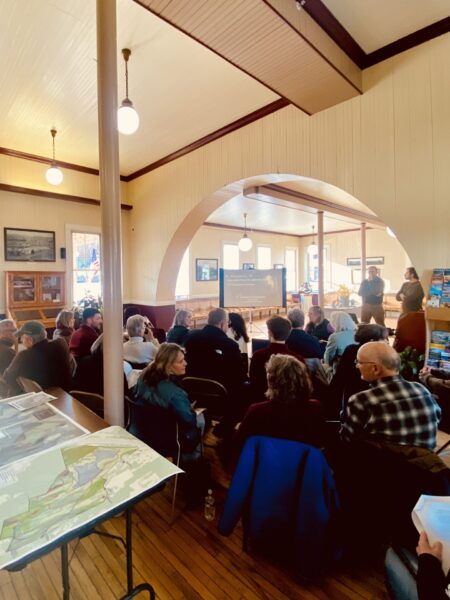
Like many, I’ve struggled lately to avoid becoming overwhelmed by a sense of hopelessness as I witness policies and executive orders on all kinds of issues with far-reaching consequences pass with little public engagement – particularly those having to do with our public lands. That’s one of the reasons a recent small-town public input meeting left me with a sense of optimism for democracy and public land stewardship I haven’t felt in quite some time.
I manage a trail stewardship grant program for the Northern Forest Center funded by the Natural Resource Conservation Service. It helps non-profits and municipalities plan or build climate-resilient recreation trail infrastructure. One of the many projects we have supported with this program has been development of a management plan for a new town forest in St. Johnsbury, Vermont.
We provided a grant to the Town of St. Johnsbury to conduct a natural resource inventory and guide a public input process to develop a management plan for Observatory Knob,” a piece of Town land with a long and storied history of stewardship and outdoor recreation. Thanks to a partnership between the Town, Vermont Land Trust, and an abutting landowner, this parcel is now permanently conserved. Arrowwood Environmental led this work, producing data on forest types, vernal pool locations, invasive species, and grassland bird habitat, and recommendations on how to manage the property for multiple recreational user groups and trail needs.
It was at a public input session on Arrowwood’s draft management plan that my dwindling hope was restored. There was certainly some spirited conversation having to do with issues related to managing humans on the landscape: such as whether to allow hunting, whether to allow bikes, where parking should be located, and whether any changes at all were needed, among others. However, people raised their hands, took turns speaking, asked clarifying questions, and seemed genuinely impressed by the amount of thought and detail that went into the draft management plan, even if folks did not agree with all suggestions.
I know that adults behaving like adults shouldn’t be a revelatory experience, but sadly public discourse these days often involves not just people talking over one another, but actively shouting down opposing opinions, with no effort to try to understand other’s viewpoints. What I saw in St. Johnsbury was a room full of people rallying around a common interest – public land – and actively exploring policy ideas that respect natural resources, abutting landowners, and various user groups alike.
I left the meeting inspired by people expressing their deep connection to place – and how that shared connection led to more listening and respect. This is one recipe for dialogue that I hope to see more often across the Northern Forest.