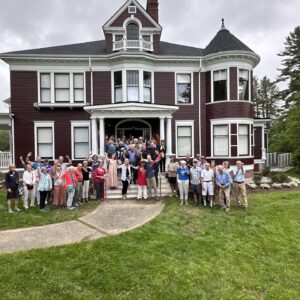
Public officials, supporters, and Center board members and staff break ground on the Center’s redevelopment project at 179 Park Street in Tupper Lake, NY.
Redevelopment Advances at Tupper Lake Property
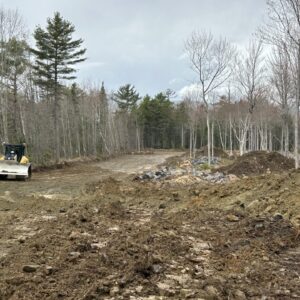
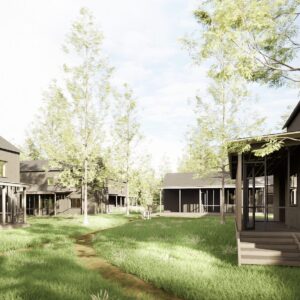
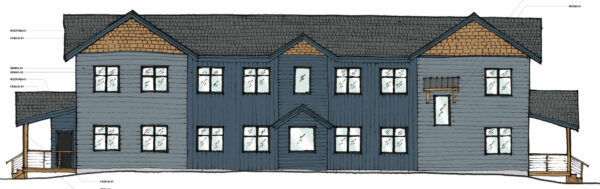
A jubilant crowd of about 60 people gathered for a groundbreaking celebration in August at the Center’s property at 179 Park Street in Tupper Lake, NY. Since the event, demolition crews have razed the old, unsalvageable building and removed the debris, leaving a clean slate for the 9-unit apartment building the Center will build over the coming year and a half.
The new building, upgrades at the adjacent property, and new landscaping will brighten the eastern gateway into the community, where the properties sit prominently across the street from the school.
Adirondack Program Director Leslie Karasin welcomed state and municipal officials, project supporters and Tupper Lake residents who came to learn about and celebrate the project at the Aug. 8 event.
Mayor Mary Fontana was the first of several speakers. “On behalf of the Village of Tupper Lake we want to welcome the Northern Forest Center here and we are pretty excited about this project,” she said. “It’s going to be a wonderful opportunity for Tupper Lake and we look forward to future projects.”
Same here,” said Town Supervisor Ricky Dattola. “We’re very excited about everything in this project. The town can’t wait for it to happen. And we want to thank Leslie. She is not only leading this effort for her organization, she is also helping us develop new snowmobile trails and new bike trails. She’s become a real asset here and we welcome her.”
Longtime Center Board member Ross Whaley shared his excitement for the project and the Center’s other housing development projects across the Northern Forest, and Assemblyman Billy Jones said that throughout his district, community leaders consistently bring up the need for workforce housing. “This [project] is important in fitting the niche for middle-market work force housing needed… here and all across the North Country!” He thanked the Center for taking on the redevelopment project.
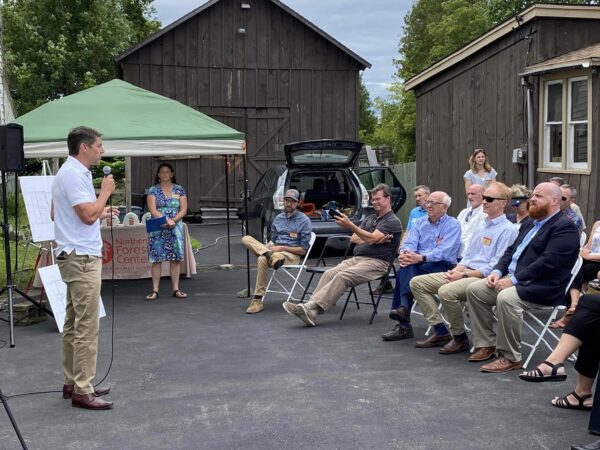
Steve Hunt, regional director of Empire State Development, which awarded a $800,000-grant to the project through the Restore New York program, said, “On behalf of Empire State Development, I want to thank all the partners involved in this project. When Governor Hochul was talking about pro-housing communities and neighborhood redevelopment, these are the types of projects she was thinking about. So, this is great.”
The audience included Barbara Rice, executive director of the Adirondack Park Agency; Jim McKenna, co-chair of the village’s Downtown Revitalization Initiative, and Kiley Peck and Jennifer Voss from the NY Department of State’s office, all of whom played a role in securing the village’s Downtown Revitalization Investment award, through which the project received a $725,000 grant.
In his remarks to the crowd, Center President Rob Riley talked about working in partnership with Tupper Lake to help revitalize the community and said the Center is proud to be a taxpayer, helping to support the services that sustain a vibrant community. “In the long-term, the building is only a building,” said Riley, “but the people who will live in it will be the ones to really lean into it and become part of the community!”
Leslie Karasin explained that the Center originally intended to renovate the existing building but realized after a full assessment that the best way forward was to remove the old building and build a new one. Before demolition, crews removed asbestos from the interior of the building.
Karasin is soliciting construction bids for the project, which should get underway in the late fall or next spring. Depending on the start date, construction should be completed late in 2025 or the first half of 2026.
The total project cost is estimated at $3.8 million, which the Center is funding through public and private grants and capital from its Northern Forest Fund.