Data That Changes the Equation
The data at the center of that work came from OSI’s Resilient Communities initiative, which maintains a proprietary hub that would otherwise be well beyond the reach of most small towns. Through this collaboration with OSI, and thanks to grant funding from Jane’s Trust and the Vermont Community Foundation, the Center gained access to that hub and shared it directly with community partners.
Yale graduate students Mia Ambroiggio and Clare Scheib-Feeley spent a semester working with officials from all three towns, analyzing risk factors, identifying vulnerable areas, and developing tailored recommendations that ranged from green infrastructure projects and floodplain conservation to zoning changes that would steer future development away from flood-prone areas.
Scheib-Feeley, reflecting on the semester’s work, said the experience reinforced something she hadn’t fully expected going in. “I’m especially grateful that the Center facilitated partnerships with helpful, experienced decision-makers from each town. They shared key community information and stories, provided feedback on our initial analyses, and will adapt final reports to their specific local needs. The project underscored that effective community engagement and place-based solutions are just as important as climate modeling and data analysis.”
For the Town of Gorham, the study built on years of work already underway. “We’ve been really hard at work on the flooding issue for about two and a half years,” Cloutier said. “It kicked into high gear in December 2023.”
What the Yale study offered was a different kind of perspective. “It brought us fresh sets of eyes form people who had no bias about what should happen. They based everything on science and modeling.” Local knowledge shaped the process too. There were places that looked one way on a map but didn’t match reality on the ground, and the team adjusted scope accordingly. “Having outside experts look at it from a different perspective was really valuable,” Cloutier said.
The study also surfaced resources the town hadn’t fully tapped and opened up new thinking on funding, identifying options and creative approaches to a challenge Cloutier describes plainly: “We know something needs to be done. It’s finding the money to do it.”
“Working with Mike Morin has been really helpful,” Cloutier said. “Anytime you can bring in people with a broader reach, it opens doors you didn’t know existed. We wouldn’t have been involved with the Yale/OSI study at all if it weren’t for the Center.”
Cloutier also noted something beyond the immediate project. “The two students who did the work could be the engineers and planners helping us fix this problem ten years from now. Getting future leaders involved is important too.”
A Risk No Town Should Face Alone
In Keene, New York, the geography tells the story. The town sits in an Adirondack valley surrounded by some of the highest mountains east of the Rockies. Its housing, businesses, and critical infrastructure are clustered along a steep river corridor carved by the Ausable River. When heavy rain falls on those mountains, the water has nowhere to go but down.
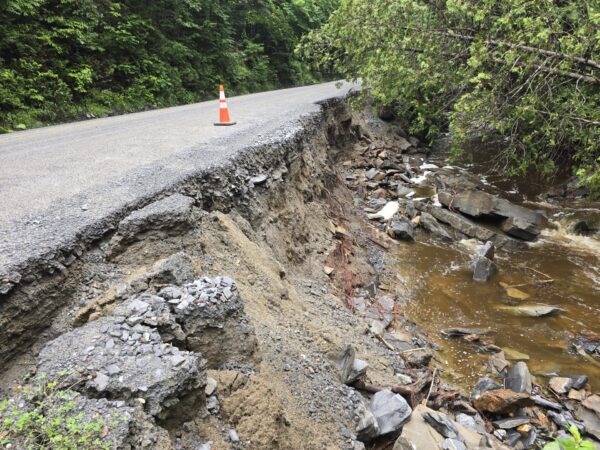
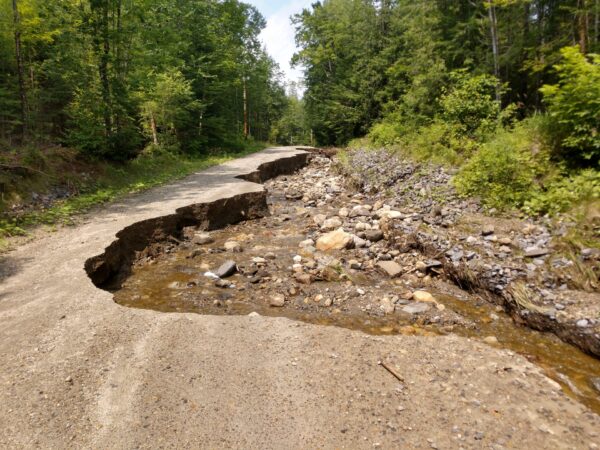
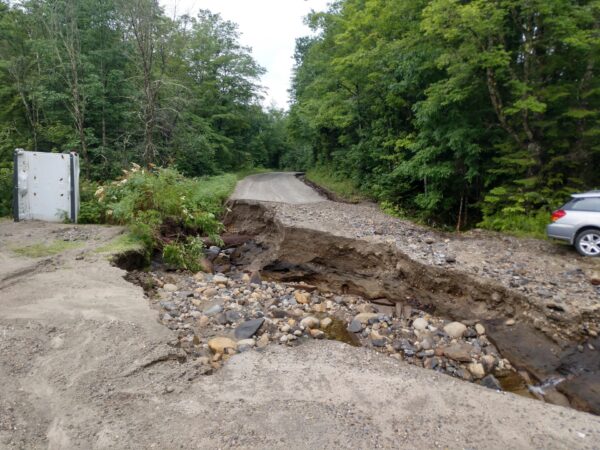
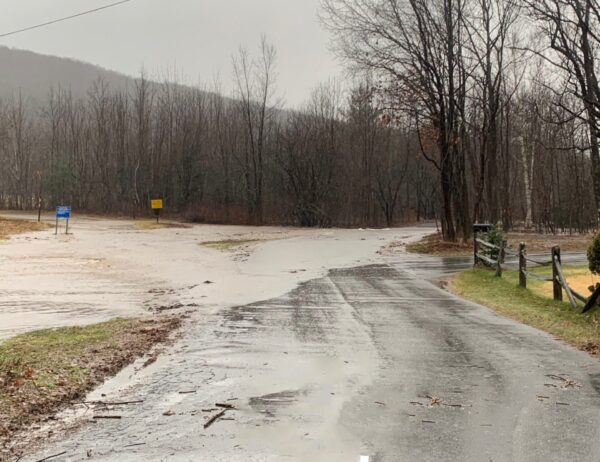
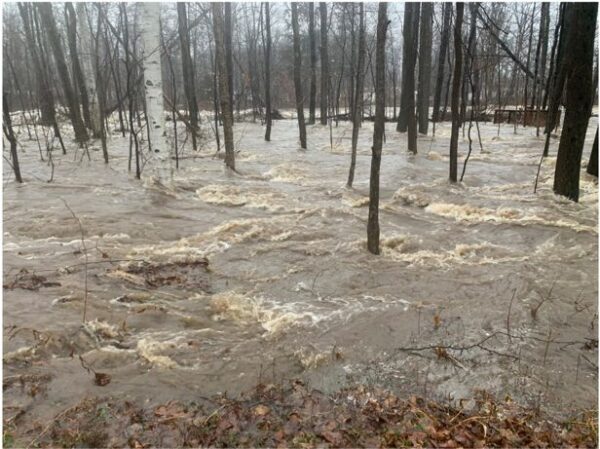
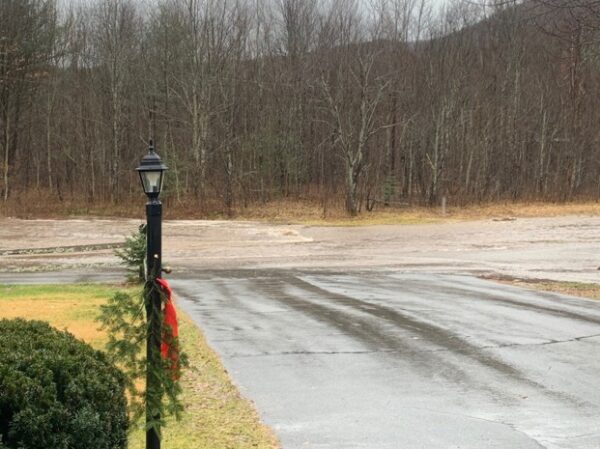
In December 2024, that’s exactly what happened. The Ausable swelled beyond its banks, swamping roads, flooding homes, and damaging Marcy Field. Routes 73 and 9N, the main arteries in and out of Keene Valley, were knocked out, cutting residents off from grocery stores and threatening the tourism economy that depends on that corridor. A local hardware store pumped water out before it reached the furnace. The town had done significant flood mitigation work in the years since Tropical Storm Irene, which prevented worse damage, but the vulnerability was plain.
What the community lacked, until now, was the data to plan around it.
“Climate resiliency is a priority for the Town of Keene,” said Town Supervisor Joe Pete Wilson. “Our small town lacks the technical capacity to conduct the research, mapping, and analysis required to plan appropriate solutions.”
The Northern Forest Center’s partnership offered something Keene couldn’t have accessed on its own. “The Center offered its highly skilled staff and students to survey potential flood plan acquisitions using the latest cutting-edge maps and climate data,” Wilson said. “The report the Center team delivered to the Town will provide foundational data for our ongoing strategic planning process. Without partners like the Northern Forest Center, the Town of Keene could not afford the sophisticated data and recommendations necessary for the effective planning and preparation.”
The Center continues to pursue climate readiness work across the four-state region, building on partnerships to help communities navigate a challenge that isn’t going away.
For Cloutier, the urgency is personal. He’s lived in Gorham for more than twenty years, in neighboring Berlin his whole life before that, and had never seen flooding at this scale until 2023.
“People forget quickly,” he said. “Keeping this in the forefront takes real effort. The big lesson is something I’ve seen with utilities: it’s easy to plan for a blue sky day when the weather is fine. But you have to spend the good days planning for the bad ones. Don’t wait for the next flood and then say, ‘We should have done something sooner.’”