A panorama of northern Vermont, taken from Greensboro.
Why We Invest: Gaye Symington and Chuck Lacy, Vermont
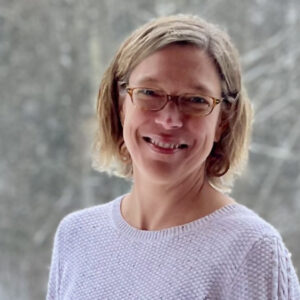
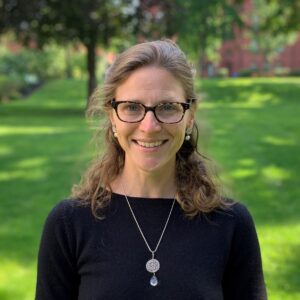
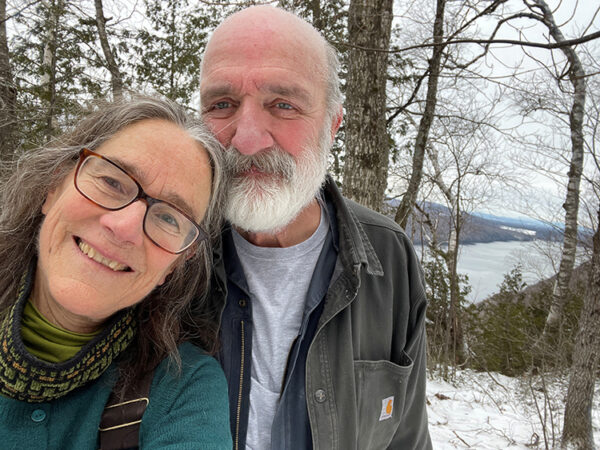
Gaye Symington and her husband, Chuck Lacy, are longtime Vermont leaders with careers in public service, foundations, sustainable agriculture, and socially responsible business. Gaye, a former speaker of the Vermont House and past president of the High Meadows Fund at the Vermont Community Foundation, and Chuck, president of the Barred Rock Fund, co-founder of Hardwick Beef, and former president of Ben & Jerry’s, live in Jericho, Vermont.
Both are investors in the Northern Forest Fund, and Gaye recently joined the Northern Forest Center’s board. Kristen Sharpless, our director of Development, took a walk with Gaye to talk about her connection to the Northern Forest and what inspires her about the Center’s work and place-based impact investing:
Kristen: Let’s start by having you share a bit about your personal connection to the Northern Forest and what inspires you about the Center’s work.
Gaye: Sure. What inspires me most about the Northern Forest Center’s work is that it’s regional in focus—not defined by state boundaries. It’s about community health, ecological health, and the economic vitality of a rural, forest-based region. I love Vermont, but it’s not inherently superior. There’s real value in learning from – and sharing Vermont’s successes with – Maine, New Hampshire, and New York.
I come from a world that tends to appreciate rural spaces as we pass through them — whether it’s farmland, forests, or mountains. That’s very different from making a living from the land. What I appreciate about the Northern Forest Center is that you work directly with people making their living from the land in ways that draw from and give back to the health of the forest. And that health isn’t just about whether trees leaf out in spring or turn red in fall. It’s about whether the forest supports livelihoods and communities.
Kristen: How did you get into mission-aligned impact investing?
Gaye: Well, at High Meadows, the board came to a clear realization: grants alone weren’t enough to drive real change. Too often, transformative ideas stalled because they needed more capital—more than a typical $30,000 or $50,000 grant could offer.
One pivotal example came when the Castanea Foundation, focused on the viability of farming, approached the High Meadows Fund and the John Merck Fund with a challenge: Vermont Creamery couldn’t get enough high-quality goat milk locally and was relying on Canadian supply, which doesn’t make sense—goat milk doesn’t travel well, and we have farms here.
Castanea proposed establishing Taproot Capital Fund through which the three funders could co-invest in a model goat farm in Randolph, VT to produce milk at scale. Taproot bought the land, contingent on others investing in the business infrastructure. Once the Ayers Brook Goat Dairy was operational, Taproot sold them the farmland and financed the sale.
Kristen: How did that experience at High Meadows affect your personal approach to impact investing?
I had been a board member of the Vermont Community Loan Fund in the 1990s when we first moved to Vermont. So, I was already familiar with the idea of taking part of your savings and putting them to work with modest financial return in order to provide loans to micro-businesses and childcare operations who otherwise lacked access to capital.
That was part of my personal history. And then seeing it play out at a larger scale through funds at High Meadows and the Vermont Community Foundation helped reinforce that approach and helped me see other ways of deploying financial assets for a mission return.
The third factor for me personally is that I wrestle with capitalism. Where are my savings and retirement accounts invested? That’s important to me because I’m retired now, and I rely on those funds—but I’m uncomfortable being part of the machinery of the stock market.
If I can invest in something I believe in—where I can see the impact, maybe even if it isn’t in my own backyard—and feel like I’m using my dollars responsibly from an investment perspective while still making a difference in the lives of rural Vermonters… that matters.
Also, helping to strike that balance between economic success, environmental stewardship, and community health — that integration matters to me. And it’s at work in the Center’s Northern Forest Fund. It’s also at work in organizations like the Vermont Community Loan Fund. We’re lucky; there are multiple mission-focused investment vehicles in Vermont. I look for opportunities where I can put my own savings to work in a way that’s consistent with my values.
Kristen: In this time of uncertainty and change, what would you want someone considering an investment in the Northern Forest Fund — or any impact fund — to consider?
I would ask you to consider: Where is your money invested? And how does it reflect your values?
There are probably more polite ways to say this, but if you’re contributing to environmental causes while also investing in petrochemical companies, what are you really accomplishing? Until we align our investments with our values, we’re not doing enough for the people who come after us.
So, the question becomes: could you do more to close that gap by directing your dollars to initiatives — like the Northern Forest Fund — that truly reflect your values?