A logging road winds through the forest in Maine’s Northern Forest in Bethel, Maine. (© 2018 Jerry and Marcy Monkman/EcoPhotography)
Why We Invest: Roger and Margot Milliken, Maine
A Fresh Focus: People and Place
Roger Milliken’s connection to the Northern Forest Center runs deep—just like his roots in Maine. As the former president and CEO of the Baskahegan Company, which manages 150,000 acres of timberland in eastern Maine, Roger’s lifework has been caring for the land his family has stewarded for generations.
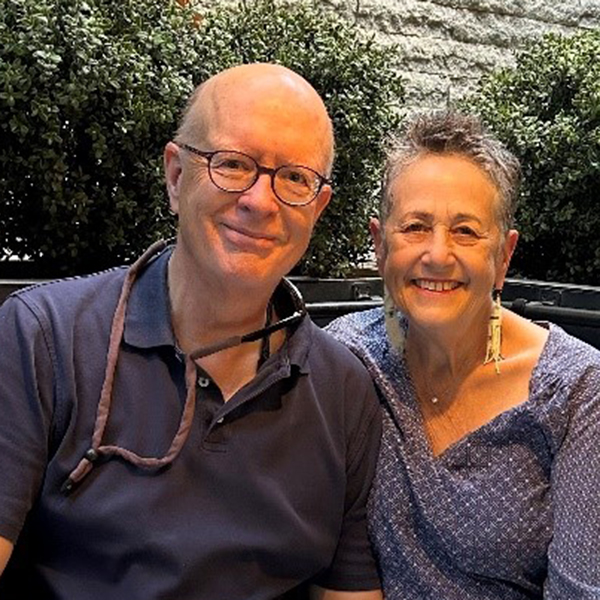
“I’m drawn to places where people still live their connections to the natural world,” he said. “There is nowhere I would rather be than Maine.”
While Roger’s leadership in land and water conservation was well established—including co-chairing two Nature Conservancy campaigns that protected 240,000-acres in the Northwoods of Maine and chairing the Conservancy’s board—the Center brought something new: a focus on people.
“I’d worked to protect land, water, plants, and animals across this region—but never on human challenges,” he reflected. “The Center engaged me in the challenges facing human communities in the Northern Forest.”
Reimagining What Money Can Do
Roger joined the Center’s board and found an organization that felt aligned with his values and ambitions. “It’s a very effective, nimble, and deeply rooted organization,” he said.
So, when the Center launched its first impact investment fund to create housing in Millinocket, Maine, he and his wife, Margot, chose to invest. The decision came after Roger participated in the year-long Just Economy Institute, which challenged him with two simple but powerful questions: Do you have enough money? Do you need more?
“Those questions unlocked something,” said Roger. “I realized I had more than enough—and that opened up creative possibilities for what more I might do with my money to make the world a better place.”
Since then, Roger and Margot have continued to invest in the Center’s impact funds, while also continuing their philanthropic support for the Center’s programs and operations. “Every December when the interest check shows up, I’m reminded how an investment is aligned with, but different from both philanthropy (it pays interest and I will get my investment back at the end of the period) and investments (these are not just transactions—they represent an ongoing relationship, a real connection to people and places).”
Multiplying impact, a powerful invitation
For Roger, investing in the Center’s impact funds is both financially sound and deeply personal. “I wasn’t motivated by trying to grow the worth of my portfolio. This was different,” he said. “It was patient capital—aligned with my values and focused on improving lives in a place I know and care about: Maine and the Northern Forest.”
And the impact? Much bigger than a traditional gift or investment alone.
“If I’m making philanthropic gifts out of income produced by my investments, I’m investing only around 5% of the funds available to me,” Roger explained. “So, when I invest the capital instead of just the income, the impact is multiplied by a factor of 20. And it’s supporting the values I care about in the world.”
Roger sees the Center’s community-driven, impact-first integrated capital model as part of a bigger shift. “The Center is asking people to think differently—not just about how much they can give, but how they can deploy their capital to build the kind of future they want to see in the world,” he said. “Especially in today’s uncertain and tumultuous times, that’s a powerful invitation.”