
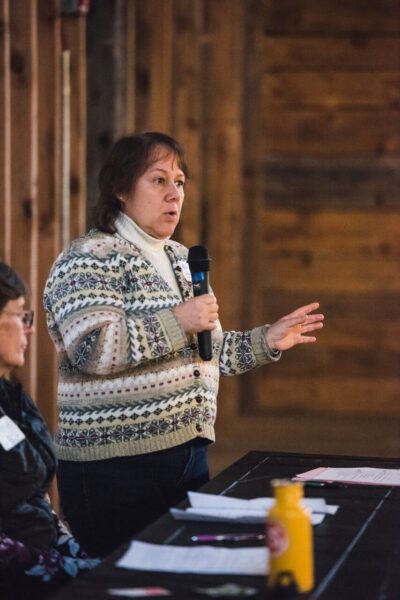
ulie presenting at Bucks Ledge Community Forest meeting Woodstock, ME at Bryant Pond 4H Center.
Leaving the forest in good hands
Julie Renaud Evans retires after more than two decades of guiding towns across the Northern Forest as they take their land into their own hands
“Every community forest is different because every community is different,” says Julie Renaud Evans, who has directed the Northern Forest Center’s Community Forest program since 2009.
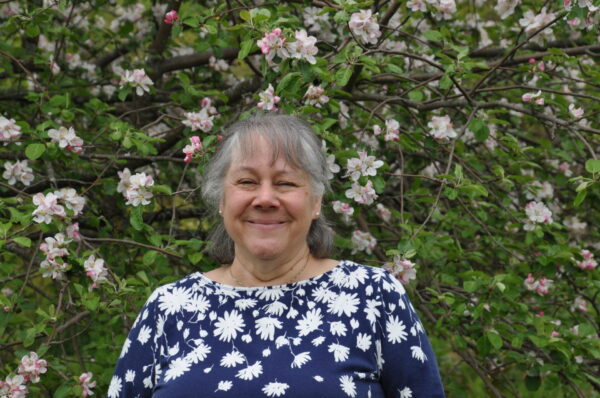
It is the line she reaches for first when she talks about this work, and it describes how she did it: town by town, meeting by meeting, never the same way twice.
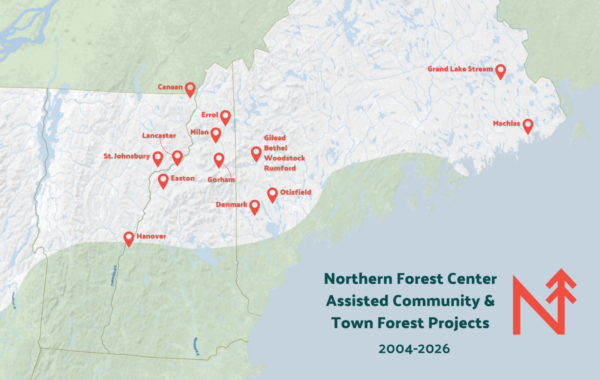
Friday, October 30, is her last day at the Center. She leaves a program that has helped 20 communities across the Northern Forest conserve more than 40,000 acres.
She arrived already carrying an unusual mix of forestry, community planning, land surveying, and teaching experience. The Center’s community forest work was still in its early years, and she has called the match a perfect fit. Today she is a regional leader in forestry circles, and the program she shaped helped a community forest movement take root across the Northeast, alongside land trusts, state agencies, foresters, schools, and funders.
The community in community forest
Town forests are an old New England idea; Newington, New Hampshire, has had one since 1710. In the mid 2000s, the Center helped establish the Community Forest as a formal model: land a town acquires deliberately, protects permanently, and manages with its residents at the table. Decisions are made by the people who live there, and the benefits stay local: income from timber, trails for the town’s outdoor recreation economy, a classroom in the woods for the school, and views and wildlife habitat kept intact.
Julie’s part in this story begins before she joined the Center. In 2005 she was a consultant to the Town of Errol, New Hampshire, guiding it through the project that became its community forest. The Center sat at the same table with Julie and the town, helping to shepherd the process. Two years later, when the 2007 report laying out what the model could offer the region’s small towns was being written, one of its key authors interviewed Julie because of that Errol work. She came on staff in 2009, and her first three years went to spreading the idea: education and outreach, showing towns what owning their own forest could mean. The Canaan, Vermont project in 2010 marked the turn from promoting the model to delivering it, and from then on she was guiding towns through acquisitions of their own.
Since then, Julie and the Center have brought community engagement, project management, and financing to 20 communities, most of them in New Hampshire and Maine, conserving more than 40,000 acres across the Northern Forest. The job, as Julie describes it, is to marry what a community wants with what the land can support. Foresters and ecologists read the land: forest type, soils, natural communities, water. The community considers what it hopes to get from owning it. Her work is making sure the second shapes how the first is managed.
Her planning process has three parts. Educate first, with field trips, walks, and bringing in outside experts, such as a peregrine falcon specialist brought in for the Buck’s Ledge project in Woodstock, Maine. Then talk through uses and values, from ATVs and mountain bikes to timber and carbon. Then synthesize it all into a stewardship plan that can run 50-200 pages.
The part she guards most is the welcome. No hand-picked committee at the onset and no fixed membership; anyone can show up in month six and still be heard. She thinks about the room, the time of day, and whether there is food for everyone, and she goes looking for the voices that aren’t there yet. “Where’s the snowmobile person? We need him at the table.” What surprises people, she says, is that they are being asked at all.
Her reach grew well beyond any single town. She facilitates the Androscoggin Valley Community Forest Collaborative, eight community forests across northern New Hampshire and western Maine that together steward 32,000 acres and learn from one another. She has put three rounds of Dartmouth seniors to work on the program, from a story map of four community forests to carbon plots at Buck’s Ledge and the development of a management database she had wanted for ten years. Besides her community forest focus, she also led the Center’s community work in Lancaster, New Hampshire, including the Parker J. Noyes renovation, and our Forest Stewardship program on wood supply, climate resiliency, and forest health.
A story for every forest
Put Julie in front of a room and ask about community forests, and she will happily go for an hour. The part she loves most is the storytelling, forest by forest, each one different from the last. “In Canaan, it’s all about education. In Errol, it’s all about ATVs. At Buck’s Ledge, it’s all about rock climbing. In Bethel, it’s all about mountain biking.” You can watch a room take that in, she says, and realize their town could do anything.
 Her own go-to story is Bethel. Eighty people came to the first public meeting about a 1,000-acre tract, and some of them were unhappy. An absentee landowner had let them use the land however they liked, and formal public access made them nervous. The team stuck with the process. Over the months the eighty settled into a core of about 25 who showed up every month, and after a year and a half of planning one of the original naysayers joined the governance committee. For Julie that is the whole point: a planning process that gives everyone a lane, skeptics included, and honors what they bring to it.
Buck’s Ledge in Woodstock, Maine, is the one she calls beloved. The ledge above North Pond has been hiked for more than a century, and the town had wanted to own it for twenty years; a 2008 attempt collapsed when the landowner pulled out at the last minute. It took until 2022, and a second try with the Center and its partners, for Woodstock to finally own all 646 acres. Every time she talks with Woodstock now, she hears community pride in holding land the town cherished long before it was theirs. She is just as pleased that the children are part of it: the town has since bought land to connect the elementary school to the forest by trail.
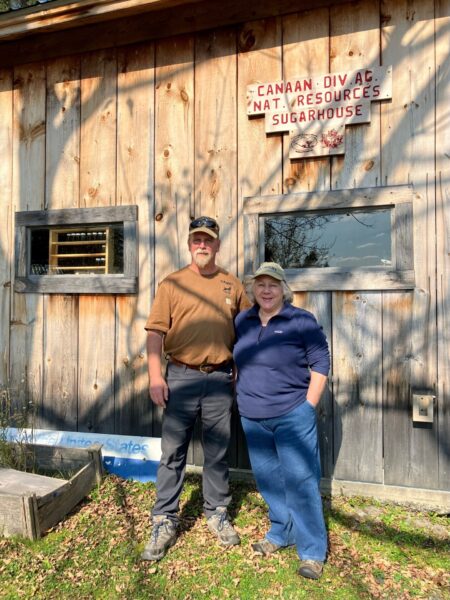
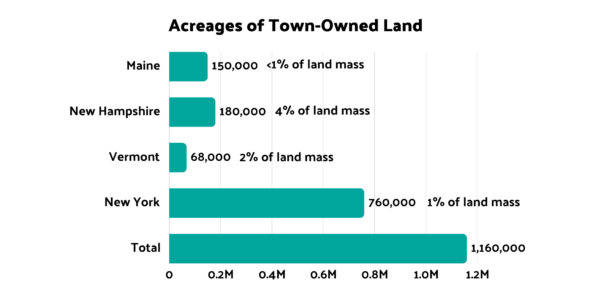
Ask Julie about the roughly 400,000 acres of town-owned forest across the region and she reaches for scale. It equals the Green Mountain National Forest, twice Baxter State Park, half the White Mountain National Forest. Spread across many small parcels, locally owned and permanently conserved, it adds up to clean water, clean air, stored carbon, and a landscape that is unable to be fragmented.
Mentor, organizer, hero
When the Center interviewed twenty partners this year about its community forest work, the answer to what makes the Center good at it kept coming back to one person, “Julie.” Rodger Krussman of the Trust for Public Land noted that it’s people like Julie, and the Center’s long term commitment to the value of community forests that makes our work effective.
Kirk Siegel of the Mahoosuc Land Trust points to her “bag of tricks,” the accumulated experience that lets her fit the process to each community’s culture, and adds that while some organizations claim they can run engagement in-house, the Center’s expertise “is special.” Kate Forrer of the Vermont Woodlands Association calls her a mentor for community forests who carried a regional perspective across state lines. Kelly Short, formerly of the Center, describes an organizer, motivator, and process leader who helps a town set clear goals and then write the plan to reach them.
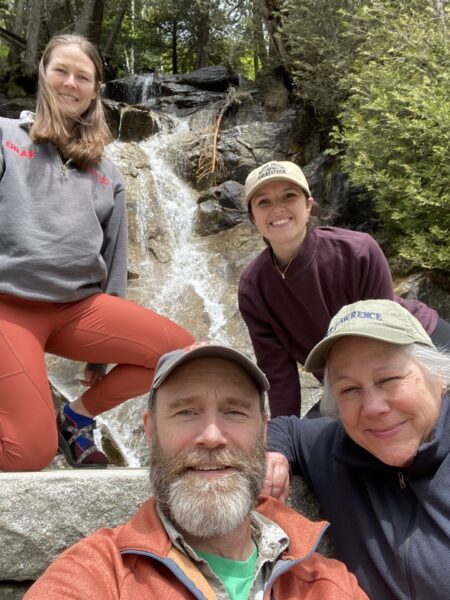
Colleague Mike Morin calls her his “facilitation and public speaking hero.” Earlier this year he watched her give a Sense of Place talk on community forests at Tuckerman Brewing, in a noisy room full of brewery patrons, with a microphone that kept cutting out. She delivered it anyway, drew questions from the crowd, and left local friends saying, in his words, “We love what the Northern Forest Center does!”
Strip away the acreage and the stewardship plans, and what her partners are describing comes down to one thing: community forests are about people. Julie would put it the same way, and then change the subject. When she sat down for the retrospective interview this summer, she opened by saying it was not about her, and that she wanted to talk about the Center.
Instilling awe
Ask Julie what the next twenty years should bring and she doesn’t lead with how many more acres. It’s a word: beloved. By that she means every community forest well stewarded and woven into its town’s life, which looks different everywhere: picnics here, hunting there, an outdoor classroom for the local school somewhere else.
She thinks town forests are the sweet size for modeling good stewardship, big enough to matter and small enough that a landowner with 50 acres can see themselves in it. And she wants the circle of support to keep widening beyond the Center, to land trusts, foresters, and schools.
She is clear about what is undone. Four states offer thin and inconsistent guidance on how town forests should be governed. Every project she worked on promised never to ask townspeople for tax money, and how a forest pays its own way over the long run is still an open question. Volunteers are the scarcest resource of all. “Small towns have trouble finding volunteers to be selectmen, to serve on the planning board, the zoning board — and now a forest committee, too,” she says. “Volunteer capacity is a real challenge.”
Retirement will mean more time in Milan, New Hampshire, where she and her husband, Kevin, walk, bike, garden, and care for a woodlot of their own. It will not mean she stops caring how this work goes. Her advice to whoever carries it forward is that acquisition was the easy part; the hard part is keeping the passion alive from one generation to the next.
“We need to instill awe in the next generation,” she says, “and an appreciation for that town-owned forest because today’s children are tomorrow’s forest stewards and community leaders.”
Regional total of community forests estimated from state inventories: about 68,000 acres in Vermont (2015), 180,000 in New Hampshire (2018), and 150,000 or more in Maine (2016).


