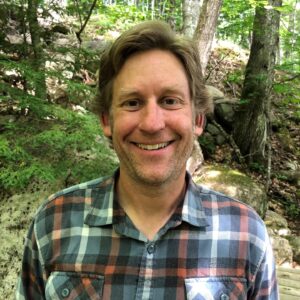
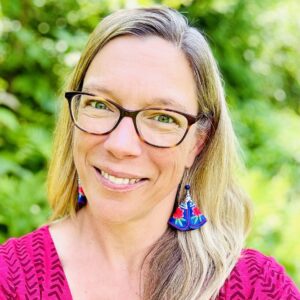
Catamount Arts Education Director Anne Campbell and writer Lori Lee.
Artists in community
Catamount Arts’ artist-in-residence program out of 560 Railroad St., St. Johnsbury, puts focus on community
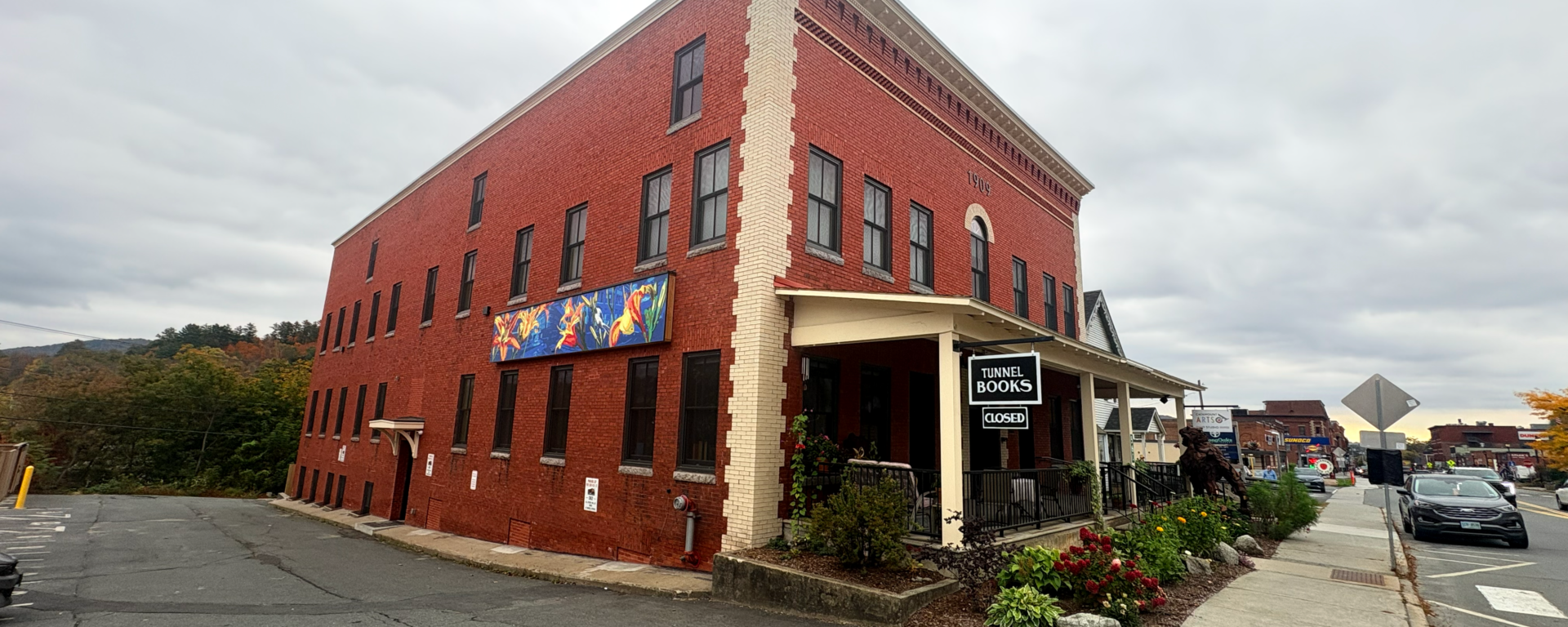
Outside 560 Railroad St. in St. Johnsbury, Vermont, stands a chimera. It entices walkers a little further down the street to look at the statue, the gardens, the historic building, and the public art.
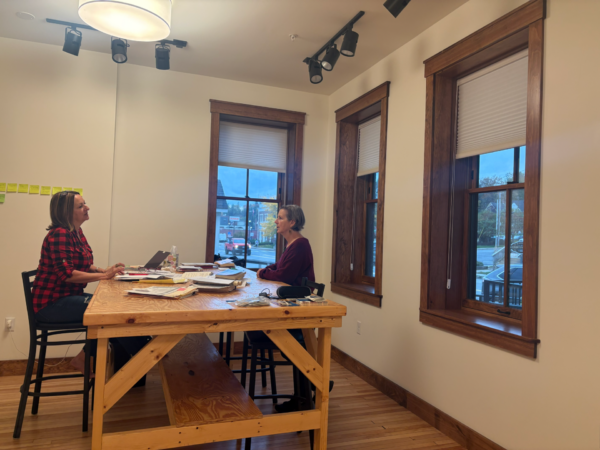
Inside, one of Catamount Arts’ artists-in-residence is at work in a brightly lit studio, a space the Northern Forest Center finished in 2025 as part of its redevelopment of the historic Bertrand’s Hall. Unlike many residency programs where artists are sequestered away, Catamount’s artists spend about 10 hours a week of their residency working within the community — giving talks, offering workshops, or leading public art projects.
“We are an arts organization that is very much focused on integrating the arts and community,” said Anne Campbell, Catamount Arts’ education director. “We decided to make it [the residency program] very community focused. So, we were looking for artists specifically whose practice was centered on engaging in community.”
Meet Lori Lee
Lori Lee, a writer from Utah, kicked off Catamount Arts’ second season of artists in September 2026. After a career as a leading outdoor recreation writer in Utah, she went on to earn her master’s in folklore and start her podcast “Love Your Story.” During her four weeks in St. Johnsbury, Lee taught workshops at a variety of local community organizations such as the St. Johnsbury History and Heritage Center, Tunnel Books, and St. Johnsbury Academy.
“My academic focus was on personal narrative — the structure and function of story,” Lee said. “Now, I’m teaching people how to reframe their tough stories, things they’ve gone through that hold shame or a sense of failure. The places where you think, ‘my life didn’t turn out how it’s supposed to. How do I move forward?’”
Lee said the artist residency program is offering Vermonters an important connection to the arts and the opportunity to broaden their worldview. With artists from across the United States and the globe, community members have the chance to see, comprehend, and imagine ideas they might not have otherwise. Likewise, it’s been important for her as an artist to work with the community.
“I’ve enjoyed talking with the people,” Lee said. “I feel like the people have responded really well to what they’re learning, what they’re working on and their takeaways. I’ve personally enjoyed teaching because when you teach, you always learn. So it’s also been a way to take things that I’m working on and share the craft with people, kick around ideas and practice. It’s a win/win.”
A deep line-up
Nine artists participated in the first season, which kicked off after the Northern Forest Center completed the redevelopment of 560 Railroad St. in 2025. Campbell said about half have been visual artists and the other half have been writers. She noted one artist also sang Balkan music, in addition to writing, and they were able to pull together a small group of Balkan singers for a concert.
The artists have also worked with school-aged children, people with dementia, and adults with disabilities. She noted the artists share information about their home, in addition to their artform. One shared what daily life in Chicago is like with the school children, some of whom haven’t had the opportunity yet to explore outside the Northeast Kingdom.
“The community’s been grateful, excited,” Campbell said. “The people who have attended workshops have been blown away by the work that they’re doing and the quality of the artists they are working with. … We’ve picked a really good crew.”
The roster resulted from a partnership with Vermont Studio Center in Johnson, Vermont. Campbell said Catamount Arts consulted with Vermont Studio Center about the residency program. They ended up partnering on the application process and the Catamount Arts’ residency became a benefit for Vermont Studio Center alumni.
“We got 77 applications — wow!” Campbell said. “We had so many good applications. We had a community committee of visual artists and writers and arts administrators. … We ended up having so many people that we liked that we thought we could get through two full seasons, maybe three full seasons.”
Lee is among the Vermont Studio Center’s alumni, having completed its residency program three times. In fact, Vermont is the only place where she’s completed residencies, crediting the community’s dedication to the arts.
“What I get from that is how much the communities in Vermont are willing to put into the arts,” she said. “Maybe I need to expand my view, but I feel like Vermont just has a lot to offer because you put focus and money into the arts.”
A dedicated space
The artist-in-residence program is in part anchored by a dedicated work and living space at 560 Railroad St., the historic Bertrand’s Hall that the Northern Forest Center redeveloped into a mixed-use building. Today, it houses two commercial spaces and nine middle-market apartments.
“The arts are such an integral part to a vibrant community,” said Mike Morin, the Center’s Vermont/New Hampshire program director. “It’s been absolutely phenomenal having Catamount Arts use this space and bring such incredible artists who spend time working with community.”
Catamount Arts began collaborating with the Center on the space well before construction even started. This allowed Catamount to weigh in on the design of the studio — suggesting track lights and a slop sink. Its downtown location also helps artists connect with the community.
“For the location to be able to be downtown within walking distance of coffee shops and places to eat is super crucial,” Lee said. “The windows here are wonderful because you need light… and when I’m stir crazy and just need to get out, I can go and walk up and down the streets and get some fresh air. I feel like the location is key to a good experience.”
The building also has another commercial space — currently home to Tunnel Books. This has proven beneficial to all involved.
“We’ve had a really great partner with Tunnel Books next door,” Campbell said. “Having a bookstore next door is just amazing, and it’s fun, so much fun. I mean, I think almost every one of our writers has done something there, either a reading or a workshop or an open mic, something, and they’re very receptive to bringing people in.”
Campbell noted foot traffic on Railroad Street used to stop at Portland Street but with the addition of the artist studio, Tunnel Books and the newly opened Caledonia Food Co-op next door, downtown has extended toward 560 Railroad St.
“I love these projects that Northern Forest Center is doing, and this is the kind of thing we need. I think this is a great model, taking something that wasn’t housing and turning it into housing, which is so much needed,” Campbell said. “We have a bookstore, we have a residency program … that brings community into the building as well as being a housing development [and that] has been really special.”