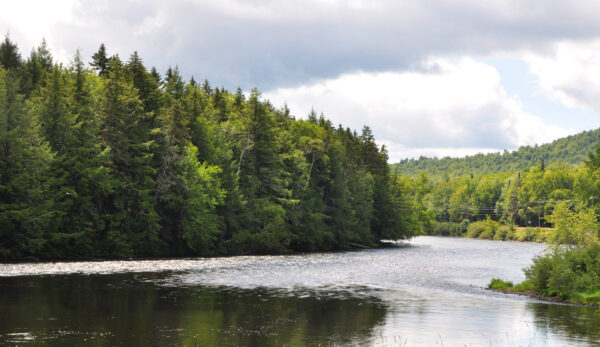
The Maine landowners group at Umbagog National Wildlife Refuge.
Connecting Maine’s North Woods foresters
Collectively managing 1.5 million acres, Center’s field visits help share knowledge, build community
Over the past year and a half, the Northern Forest Center has been building a community — a peer group of foresters and land managers representing many large landowners across Maine’s North Woods. A round-robin approach to field tours has provided three opportunities for the group to be hosted by peers and see a sampling of their forestry.
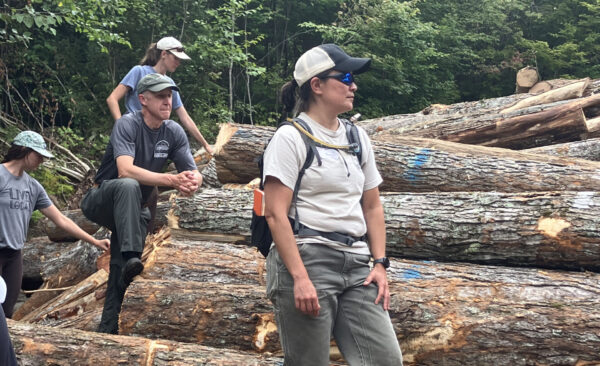
Amanda Farris is a forester with The Nature Conservancy in Maine and has spent most of her career working in and thinking about forests. “These field visits provide an important opportunity for us to get together in the woods, see something cool, and learn together. We connect at other professional meetings, but these usually have a focused agenda and other targeted outcomes. This group helps us build a community and build trust, which is good for us, good for the forest, and what we need as approaches and thinking around forest management shift over time.” Farris’ appreciation captures the Center’s goal for this group: providing an opportunity for a relatively small group of foresters managing a large portion of Maine’s forested landscape to connect and learn from one another.
The forests of northern Maine have a long history of forest management and supply the bulk of the wood resources harvested from the region. Management philosophies and approaches have evolved over time, as have the ownerships of large acreages. Current landowners include conservation organizations, commercial or industrial enterprises, investment owners, tribal nations, the federal government, and the state of Maine — all with different goals and objectives to consider in their approach to forest management.
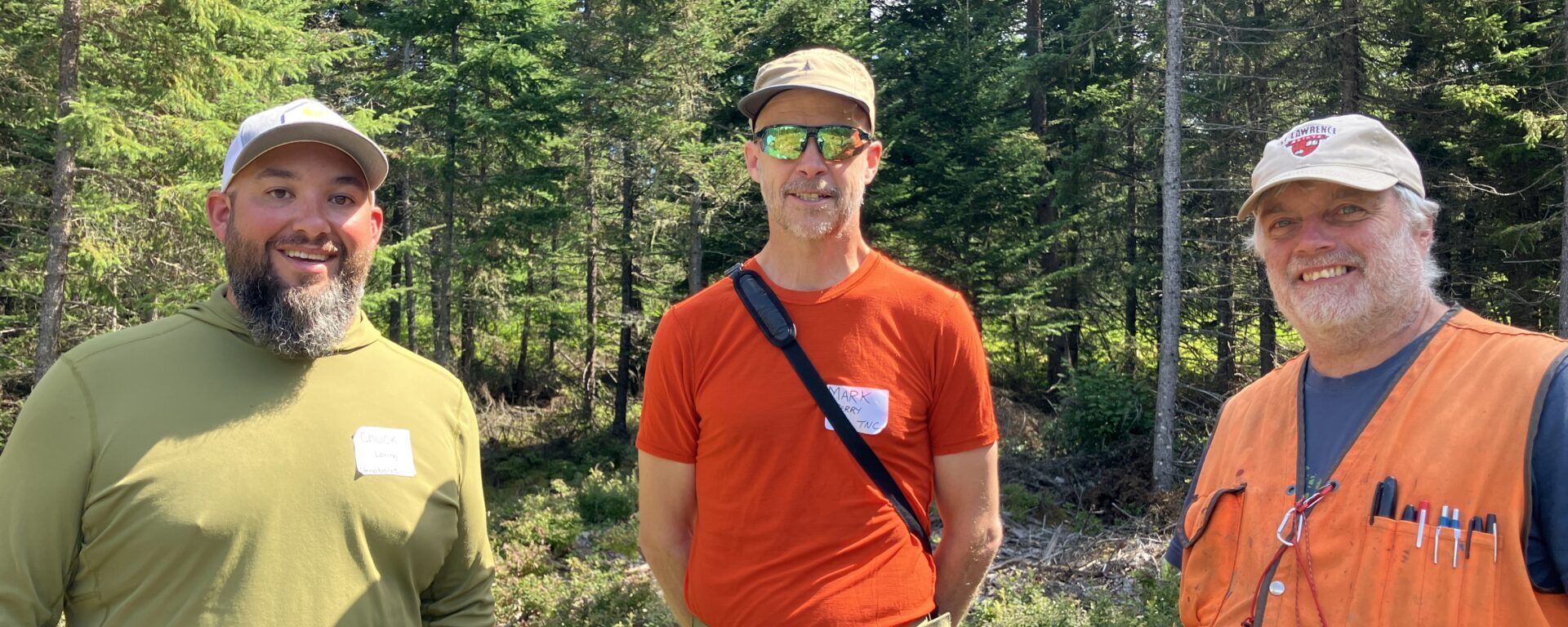
Recognizing this variety, the forest landowners engaged in this peer group include: The Nature Conservancy, Appalachian Mountain Club, New England Forestry Foundation, Maine Mountain Collaborative, Weyerhaeuser, Baskahegan Co., J.M. Huber Corp., Wagner Forest Management, Penobscot Nation, Maine Bureau of Parks and Lands, and Maine Forest Service. Although the number of landowners is relatively small, their foresters collectively manage approximately 1.5 million acres of forest.
Appalachian Mountain Club’s Gorman Chairback
Our first field tour was hosted by the Appalachian Mountain Club out of its Gorman Chairback Lodge in June 2025. Steve Tatko, AMC’s vice president of land and conservation, and Carolyn Ziegra, AMC research forester, led the group to a variety of sites highlighting their work to marry commercially viable operations with ecological forestry approaches. Tour stops included pre-commercial management to improve growing conditions, management tools to address an overabundance of young beech on some sites, even plantings to shift species composition to a more desirable and future climate-adapted mix. A fish passage project, where a small culvert was replaced with a more flood-resilient bridge, has allowed for salmon to make it further upstream, and resulted in the farthest inland detection (in terms of miles of stream from the ocean) of salmon in the state.
Along the Golden Road
In January 2026, Trevor London, director of operations for J.M. Huber Corp., along with his team, hosted the group deep in the North Woods, traveling roughly 60 miles west from Millinocket along the Golden Road — a 96-mile private logging road that runs from Millinocket to the Canadian border. In this more commercial landscape, discussions ranged from the benefits of creating improved wildlife habitat such as deer wintering areas to a variety of challenges related to conducting management activities prior to commercial harvesting, particularly around costs, workforce availability, and related federal changes. Of note were workforce challenges and considerations in such a remote landscape. Huber provides on-site housing that foresters, logging contractors, and seasonal crews all live at during the work week, with many commuting four hours or more at the start and end of each work week.
Umbagog National Wildlife Refuge and Second College Grant
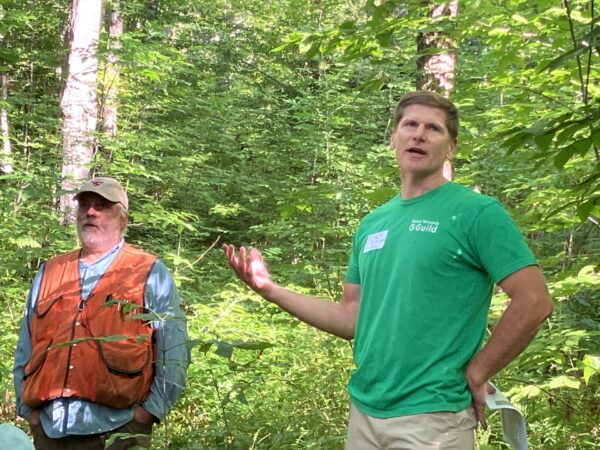
Most recently, in August 2026, the group had the opportunity to tour the U.S. Fish and Wildlife Service’s Umbagog National Wildlife Refuge and Dartmouth College’s Second College Grant, seeing both long-term approaches to forest management and ongoing applied research. The focus at Umbagog, as presented by USFWS Wildlife Biologist Sean Flint, was on forestry to improve habitat for a variety of focal species, while maintaining the Refuge’s commitment to contributing to the local wood economy. At the Second College Grant, long-tenured Director of Woodlands Operations Kevin Evans shared opportunities to look at some of his management objectives to improve forest health and habitat while continuing regular harvest operations. A unique feature of the Grant is the opportunity to expose Dartmouth students to the forest — through recreation, research opportunities, and even on campus wood products in the form of maple dorm furniture fully sourced from the Grant.
Reflecting on this most recent tour, Farris said, “I was struck by how keeping long-term objectives in focus aligns with desirable outcomes on former industrially-managed lands – increased healthy spruce across the landscape, increased resilience against future spruce budworm or other forest health concerns, improved structural complexity and habitat for a variety of associated plants and animals at home in these ecosystems, and long-term economic viability.”
The final segment of the tour was led by both Evans and Dr. Tony D’Amato, professor of silviculture and forest ecology at the University of Vermont. D’Amato initiated the multipartner installation of an Adaptive Silviculture for Climate Change project in partnership with Evans and led the group through different treatment areas and approaches, pausing to discuss and reflect on the benefits and challenges of each. While we absolutely need long-term research, like the work conducted on our federal experimental forests, this real-world example of how practices can be applied is critical to their potential for wide-scale adoption.
The pace of change relative to the constellation of forest landowners in northern Maine has accelerated in recent years, making the trust and connections this landowner group fosters even more important — for foresters, as well as the forests they manage. As approaches to management continue to evolve to meet the challenges of the day, a community of foresters who know and understand each other is one more tool to increase forest resilience.