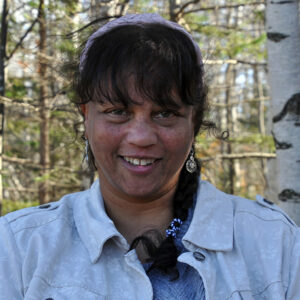
Colleen Goodridge (L) and the Center’s Business Advisor, Amy Robinson, discuss business plans for the mill.
Driving Innovation to Support the Wood Products Supply Chain
Center Helps Vermont’s Goodridge Lumber Position for Growth
When it comes to strengthening the regional forest economy, the Center leads at the regional level with programs like the Future Forest Economy Initiative – which helped launch 10 new forest products and leveraged $15 million of private investment in the sector – and at the local level, helping businesses with the assistance they need to continue as critical links in the forest products supply chain.
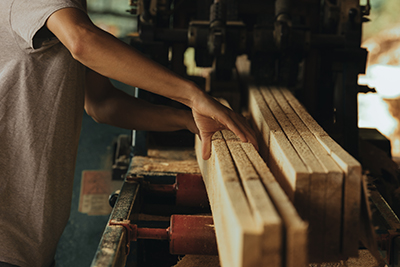
Goodridge Lumber, for example, does business with 60 local landowners, loggers, and truckers annually. It supplies 280 retailers in Vermont and more than 15 wholesalers in New England with sustainable products that replace plastic, concrete, or steel, all of which are carbon intensive products.
“We take a lot of pride in what we do, the products we make,” said Colleen Goodridge, cofounder of Goodridge Lumber in Albany, Vermont. “And we work with a great group of people – loggers, landowners, truckers. We don’t stand alone. Unless we have all of them, we don’t have an industry.”
The Goodridge family is celebrating 50 years in business by positioning the company for growth and continued community service. But it has not always been easy. Over the past 25 years, dozens of local sawmills in Vermont have closed, straining the supply chain. This past year, Goodridge faced the challenge of how to power its mill as its old diesel generators aged out and new ones would have consumed too much fossil fuel.
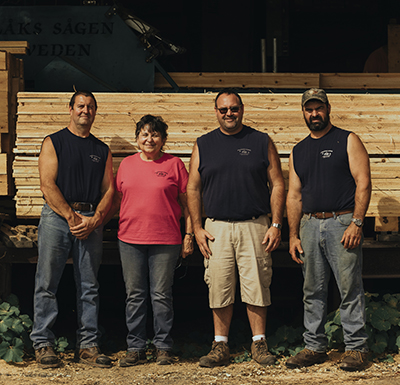
With help from Amy Robinson, the Center’s business innovation advisor, Goodridge secured a grant for more than $225,000 so it could switch from diesel to 3-phase power from a local utility, enabling the mill to continue as a critical link in the local forest economy. The new power opens the possibility of making value-added products and adding a drying kiln in the future. “We never would have gotten to this point without the Center’s help,” said Colleen.
Goodridge mills about 1 million board feet a year, and almost all of it is white cedar sourced from the working landscape within 75 miles of the mill. “We buy locally and deal with dozens of suppliers, from 1-person operations on up to larger, more mechanized businesses,” said Colleen. “We serve our community by providing products to them. And we’re a business using a natural, renewable product. It’s a complete circle. When that circle works, you’re successful. You empower others.”
Each wood product business to which the Center provides consulting, training, or resources is an important link in a chain that begins with landowners and foresters, relies on loggers, truckers, and mill workers, includes designers, craftspeople, and technicians, and ends with wholesalers, retailers, and ultimately customers. Losing one business could mean the end of livelihoods for people up and down the supply chain.