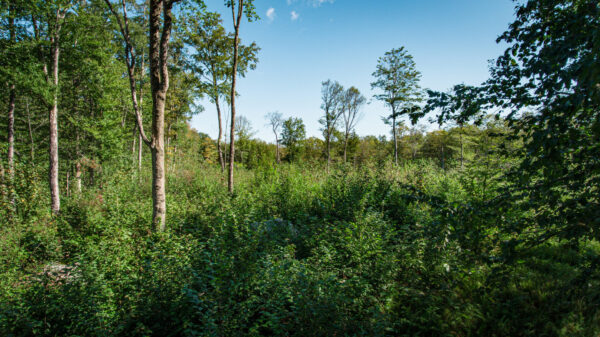
Looking into the burned area from the containment line in Ely, Minnesota.
Smoke in the sky: Wildfires highlight need for holistic management of Northern Forest
Part of The Forest Advocate series
It was hard to miss. Last week, a hazy, orange sky obscured our views, triggering air quality warnings for tens of millions of people in the Northeast and Midwest and upending the regular cadence of summer activities. Fires in the Boundary Waters of Minnesota and a larger complex of Canadian wildfires were the cause, and nine U.S. Forest Service wildland firefighters from the White Mountain National Forest headed west to help.
On that crew is Ian Gurney, a New Hampshire-based timber sale administrator for the USFS. He’s also the brother of the Center’s Kendra Collins, who shared Ian’s updates from the fire line. Ian shared that the forest they were working in felt “a lot like northern Vermont.” This struck a chord. We often think of wildfires as a western forest issue, but Ian observed similar fuel types to what we find in many parts of the Northern Forest — “basically the same mixed wood structure in terms of forest type and density.” The fire his crew was assigned to was caused by lightning and grew from 6 acres when they left New Hampshire to over 12,000 acres as they touched down in the area.
It’s a wake-up call for us. Who would have thought that northern Minnesota — or the Northern Forest — might be susceptible to this scale of fire? Of course, we know the climate is changing, and scientists anticipate our region will experience more extremes with increases in incidence and severity of fire, drought, flooding, pest infestation, and invasive species.
Scientists, foresters and other experts can help us hopefully stay one step ahead of these dire projections. We, as forestland owners and advocates, can also lean in to support healthy and resilient forests in the face of climate change with a commitment to a holistic, long-term, and multi-pronged strategy for forest stewardship. Together, we can advocate for a comprehensive and robust proactive approach that includes:
- Consistent and non-partisan scientific research to understand how forests are changing and the stressors they are facing, and the impacts of different management strategies and approaches to increase resilience.
- Expert capacity at public forest agencies consistently resourced at the state and federal levels.
- Robust and durable markets for wood and wood products.
- Modern and cohesive public policies to support public and private forest management.
- Appropriately priced and scaled grant and investment capital to leverage innovation and attract additional private capital into the forest economy.
There are many ways to be active on these fronts right now. The Center team and many others have been engaged in pushing back on a proposed restructure of USDA and the Forest Service, including the proposed closure of experimental research forests that provide critical long-term data and science on how forests are adapting to climate change stressors.
We’ve been vocal about the importance of the Forest Service State, Private and Tribal Forestry, for which the federal administration has proposed to end all funding. These federal programs and funding sources are applied locally to support many programs that help landowners understand and practice forest stewardship. There is no substitute for local knowledge, and in many cases the time to address extreme conditions is with management strategies applied well in advance.
We’re part of national and regional efforts to develop new markets for wood, since without markets, the economics just don’t work for the application of ecological forestry and other approaches that create the diversity forests need to be resilient. Our region got a challenging reminder of the importance of markets this month when New York and Vermont landowners and loggers lost one of their last remaining markets for pulpwood.
And we’re watching federal policy through participation in groups like the Forest Policy Working Group. There are several important legislative efforts in play right now with impacts on forests and rural places, like the Farm Bill, annual appropriations, and the Fix Our Forests Act. It is critical Congress continue hammering out agreements on these bipartisan issues and get bills done.
Ian describes his fire crew as “normal people who care greatly for natural resources and people. And if we can protect both then it’s a rewarding win-win.” He’s right, on the fire line and the broader context. Investing in forest resilience is good for forests, and for all the ways people benefit from them.
Smoke in the sky is a call to action that we need to invest more — not less — in the science, forest agencies, wood markets, and management tools that give forests the best odds to be resilient in the face of climate change.