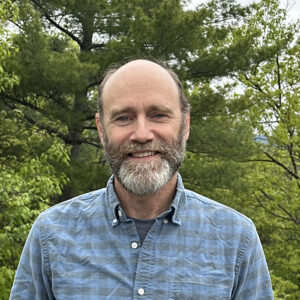
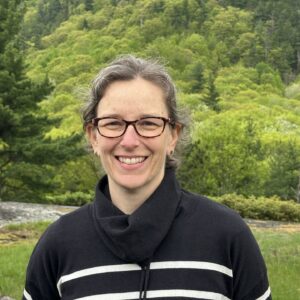
Maine West participants in the early years.
10 years of Maine West: How trust turned into opportunity
In 2015, the Betterment Fund handed the Northern Forest Center an unusual assignment: no set program, no defined deliverables, just a broad charge and a decade to figure out how to meet it. “We were given a completely blank slate,” said Mike Wilson, senior program director at the Center, who has helped lead Maine West since its earliest days. “The charge that we were given by the Betterment Fund was to increase collaboration across the economic, health, education, and conservation sectors. That was it. And to take 10 years to do that.”
What came out of that decade would have been nearly impossible to envision at the outset: a broadband buildout, an education and workforce initiative now expanding into a second Maine region, a recovery program now fully run by a community organization, and four town select boards that had never regularly met before now sharing a quarterly potluck.
A wide-open mandate
With a blank slate and a decade to fill it, Maine West’s first task wasn’t launching programs. It was figuring out where a dozen different organizations actually shared ground. The partnership landed on three categories that cut across every partner’s mission: broadband access and adoption, educational attainment and aspirations, and active communities, including conserved land and trails.
That early work depended on someone dedicated to holding the group together, a role that eventually fell to Amy Scott, program director at the Center. She now manages the Center’s education partnership work and has staffed Maine West’s day-to-day coordination for years. Brendan Schauffler, network facilitator for the Oxford County Wellness Collaborative, a Maine West partner since the beginning, has watched what her role made possible. “When Amy Scott began to provide support for the group, we grew by leaps and bounds,” he said. “Her coordination and facilitation have been an enormous part of the success of Maine West, and it’s hard to imagine us being where we are without her. At the heart of everything is human connection. Amy excels at creating the space for these connections to flourish and for trust to deepen.”
Building the trust that made ELO possible
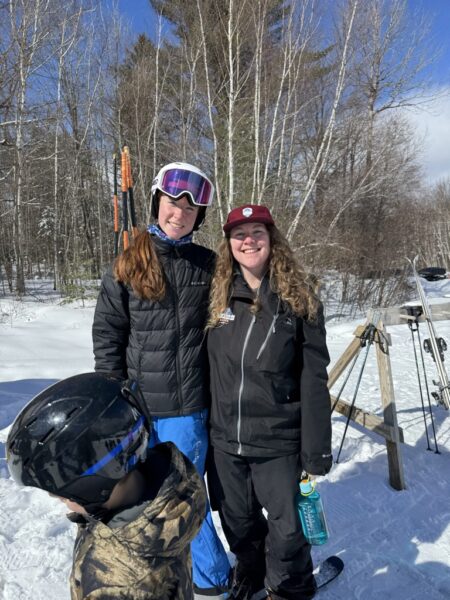
Before there was an Extended Learning Opportunity (ELO) coordinator in each school to help provide students with hands-on learning related to career exploration, Maine West invested time in convening superintendents and district leadership as part of a broader effort to listen and learn about the challenges facing students and educators. The biggest lesson was about trust, and how easily grant funding can break it. “Schools were very wary of grant-funded projects because they’re big systems that move slowly, have tight budgets, and they get approached a lot with, ‘hey, we’ve got some grant funding, we’d like to do something with the school,'” Wilson said, “It’s great for the one or two years the funding is there, but then it goes away. If it’s been a successful program, they find themselves in a very awkward position: dropping something they think is working or figuring out what else to cut from the budget to keep it.”
Rather than lead with another grant, Maine West spent a couple of years funding school professional development, provided by Korah Soll, executive director of Rural Aspirations Project, and helped the 4-H Camp and Learning Center at Bryant Pond hire a full-time Maine West education director, a trusted local resource with no agenda beyond being helpful to schools. That hire has since grown into a standing Education Program Team, still anchored at Bryant Pond, working across all four districts on place-based learning that fosters mentorship, school-community connections, and resilience through nature-based experience. The work spans K–12 resilience building, expanding 7–12 mentorship based on the NorthStar program in in School Administrative District 44, teacher training, and, largest in scale, the Maine West Workforce Initiative, which delivers Early College courses, entrepreneurship training, and workforce experiences to students in grades 9–12.
That trust is exactly what showed up when the U.S. Department of Labor’s Workforce Opportunities for Rural Communities grant became available in 2023. Two schools had already piloted ELO for one year through a state grant. When offered the chance for three years of federal funding, professional and program development, and regional support for business and community partners, all four Maine West superintendents said yes almost immediately because of years of relationship-building that came before. “There’s no way we would have been able and ready to respond to the federal Department of Labor grant if not for those years of building the relationships,” Scott said.
What followed: ELO coordinators in five high schools across four school districts, embedded professional development from Rural Aspirations, and a track record strong enough that when the three-year federal grant ran out this year, ELO remains present in all five schools. “All of those are in the budget in each of the districts, not being funded by grant funds moving forward,” Soll said. Because of a constellation of programs supporting youth aspirations and attainment, 95% of Telstar High School students now leave with an articulated plan for after graduation.
One Dirigo High School freshman, adamant about wanting to be a tattoo artist, was able to job shadow at a local tattoo shop through her ELO coordinator. “After doing that, she’s like, ‘I need to go to the two-year degree at Central Maine Community College and get a business degree in order to do this,'” said Superintendent Pam Doyen. “Her trajectory just amplified once she had that opportunity.” At graduation, that same student, who’d spent her school days pushing back against authority, stopped to tell Doyen, “I understand now what you were doing.”
From group adventure challenges to targeted programs
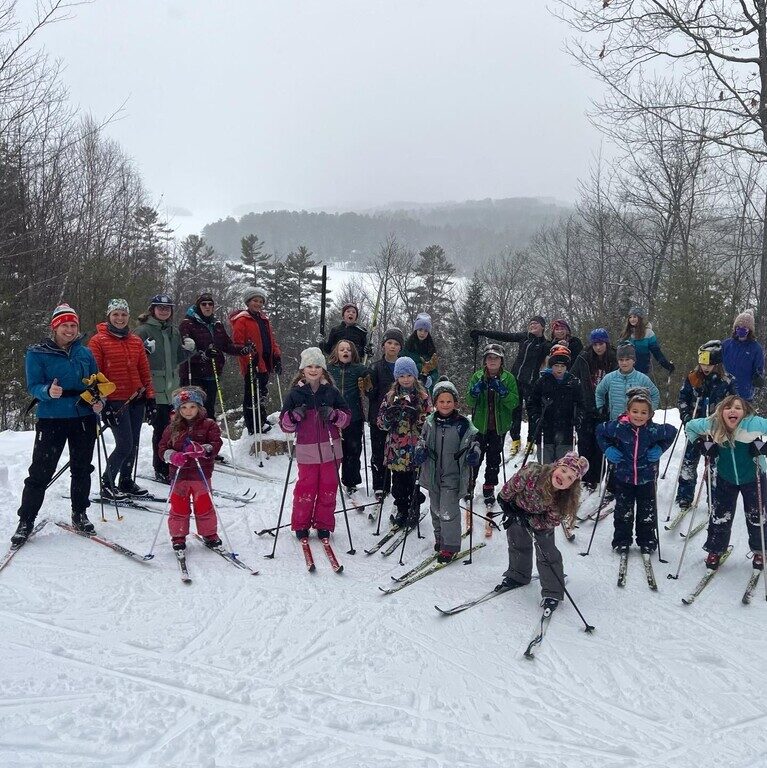
Maine West’s very first program funding went toward trail development, funding staff capacity for Inland Woods + Trails to work on the Bethel Community Forest starting around 2015, along with grants to Mahoosuc Land Trust and Western Foothills Land Trust.
Later, when the Chadbourne Tree Farm came up for sale, the three regional conservation partners, Inland Woods + Trails, Western Foothills Land Trust, and Mahoosuc Land Trust, each had interest in different parts of it. A standing relationship through Maine West helped them coordinate their response and support each other’s efforts.
More broadly, Wilson credits Maine West with encouraging land trusts, traditionally focused on protecting land for its own sake, toward community engagement as part of that mission. Community forests in Bethel, Buck’s Ledge, and Rumford reflect that shift. “The Maine West collaborative was very supportive of all of those projects.”
A separate program, the Second Nature Adventure Challenge, paid out prize money to local youth programs and food pantries when the region hit seasonal outdoor-activity goals, contributing more than $30,000 across eight challenges. But much of that turnout came from people already active outdoors, not the residents the program intended to reach.
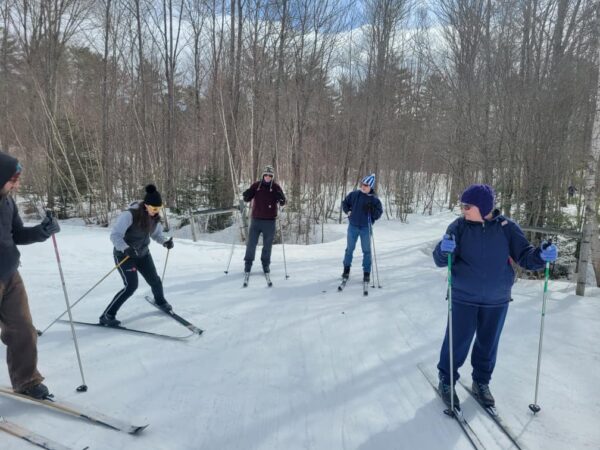
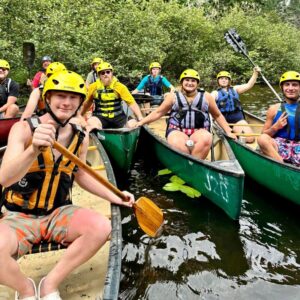
Maine West shifted its focus toward older adults and people in recovery from substance use disorder. The older adult outings, in the River Valley and Oxford Hills, are still going. The piece that really took off was Recovery Outings, developed with Oxford County Wellness Collaborative and the Western Maine Addiction Recovery Initiative (WMARI), a community organization outside the Maine West table. With the support of Maine West and other grant funding WMARI was able to secure additional capacity, including dedicated staff with the skills to support participants in outdoor activities. Today, Western Maine Recovery Outings includes events such as hikes, picnics, and canoe trips, that regularly draw 20–40 people from Oxford County and beyond.
Participants describe the outings in personal terms. “That was a hike, and I almost cried because I had wanted to go on a hike for a year and a half, and I never went,” one said. “I was really excited for that one. And when we flew the kite together, finally, it was awesome.” Another described the simple relief of showing up and said, “There were so many sober people there, and it was just so nice to see all the people recovering.” A third put it more plainly: “The ability to be vulnerable and share in a supported, healthy space. It is priceless.”
Maine West has since largely stepped back; WMARI now runs Recovery Outings outright and has raised its own funding. “It’s kind of a perfect Maine West thing,” Wilson said. “We incubated it, identified a need, put some resources to it, and piloted it. From that, it has emerged as a self-sustaining program that’s helping people in the area.”
Building broadband, one town meeting at a time
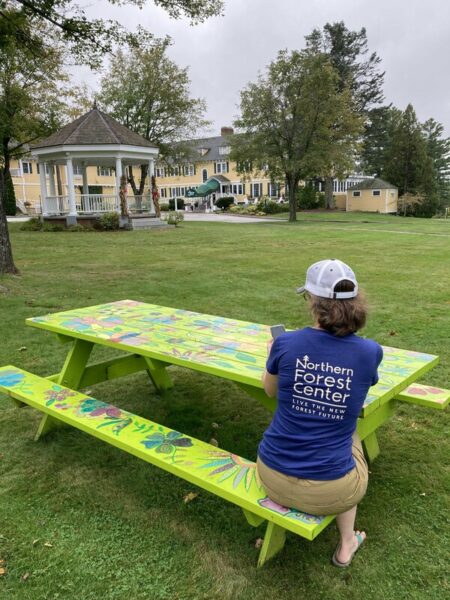
Maine West’s broadband work started with listening: community information sessions to understand what people had and what they were missing. That work found its champion in Mia Purcell of Community Concepts Finance Corp., who has since retired. “The stuff would not have happened without Mia,” Wilson said. An early planning grant funded a regional assessment, which revealed not just a service gap but a capacity gap. “The communities’ readiness and capacity to get into the issues was just really limited,” Wilson said.
Maine West was already planning an in-person “broadband boot camp” for summer 2020 when the pandemic hit and broadband became a critical public issue overnight. Before pivoting the boot camp online, the partnership moved fast: delivering at least 250 cellular-enabled tablets to students in the Bethel, Oxford Hills, and Rumford school districts so kids without home internet could keep doing schoolwork. The boot camp ran as an eight-part series over eight months, drawing representatives from a dozen communities through a crash course on broadband financing, ownership models, and community engagement. One cluster of towns, Bethel, Newry, Woodstock, Greenwood, and Albany, along with Oxford County government, leaned in proactively and formed the Mahoosuc Community Broadband Committee, with Maine West providing staffing and funding support.
Years of household-by-household mapping, ISP presentations, and financial modeling followed. The committee ultimately chose to work with First Light Fiber, the region’s incumbent phone company, over building a municipal system that would have required more local capacity than the towns actually had. As a result, First Light was able to partner with the towns to secure a $5.5 million grant from the Maine Connectivety Authority as part of an 11.5 million regional fiber expansion. The fiber-to-the-premise buildout for the Mahoosuc region took about six years, finishing just months ago. Bethel is already experiencing a direct return: After fiber became available, the town consolidated internet service across its town office, fire station, and water district, saving roughly $12,000 a year. Just as lasting, the four select boards that came together through the broadband work still meet quarterly, rotating a potluck between towns. “This kind of collaboration and communication had never happened before,” Wilson said.
What comes next
Some Maine West experiments fizzled. Others, like Recovery Outings, outgrew the partnership entirely. Ten years of that work has converged on a single answer to what Maine West does next. “Everyone came to recognize that they all had an investment in the future of youth in the region,” Wilson said. “Engaging youth is important for conservation purposes. It’s important for long-term economic viability. It’s obviously important for education. It connects directly to health issues.” Whereas the first decade was intentionally wide open, testing ideas across four sectors with no single strategic plan, partners now want a tighter point of focus. Investing in youth as a long-term rural economic development strategy has become that focal point, with the ELO work as its clearest grounding example.
“Even we were somewhat taken aback by the magnitude and impact of the work that has been accomplished by Maine West over this period,” said Nancy Stowell White, trustee at the Betterment Fund. “Sometimes it’s hard to appreciate the big picture when we look most often at the annual, incremental steps. The aggregate view is something else!”
With a 10-year track record behind it, a workforce grant that outlasted its own funding, a broadband buildout that changed how four towns work together, a recovery program that built its own wings and flew, Maine West’s partners are making the case that long-game, cross-sector investment is worth doing again.