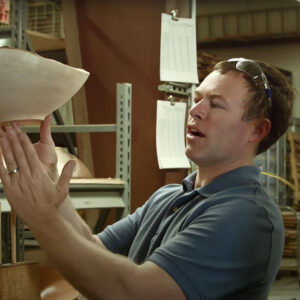
Stratton Lumber mill yard
Increasing Efficiency & Production at Stratton Lumber Mill Yard
The Stratton Lumber mill yard sprawls across 85 acres in the village of Stratton, at the southwestern tip of Flagstaff Lake. It processes millions of board feet of softwood construction lumber annually.
General Manager Jed Whiting said a typical week sees about 100 log trucks coming in and another 90-100 going out with finished product, in addition to 100 trucks with residual material from milling. “We need to get different streams of product where they need to be, efficiently. Both incoming and outgoing trucks,” said Whiting. “We need to create an environment that allows everybody to do their work in most efficient way possible.”
The Center helped Statton Lumber create that efficiency and increase production by paying half the cost of a lean manufacturing expert to improve the workflow throughout the sawmill’s log yard.
Wayne Messer, senior project manager at the Androscoggin Valley Council of Governments (AVCOG) and the Maine Manufacturing Extension Partnership (Maine MEP), worked with Stratton Lumber to develop a new workflow for the lumber yard based on lean manufacturing principles, with half the cost paid by the Center’s grant program.
“Our goal is to more efficiently manage our current level of business and to increase in the future without increasing our acreage.”
Stratton Lumber sources all its spruce and fir from local loggers and its own log yards throughout New England. The nearly 400 weekly truck loads going in and out of the mill are run by owner-operators and truck brokerages, so the mill’s economic impact flows far across the region.
“If we increase production at the planer mill, it’s good for everybody,” said Whiting. “Being able to do this project has given us interest and insight into how we can implement more lean procedures in other parts of our facility. We’re inspired to use these methods elsewhere.”
The Center supports innovation in the wood products industry with a combination of in-house expertise and financial assistance as funding allows to enable companies to contract with the experts they need to make big improvements in their companies.
The program has been supported by the Northern Border Regional Commission, the U.S. Department of Agriculture-Rural Development, the U.S. Economic Development Administration, the U.S. Endowment for Forestry and Communities, the Sewall Foundation, Maine Timberlands Charitable Trust, other foundations and private contributions.